
Introduction
How to Clean and Maintain an Under-Sink Water Filter Housing The cartridge change date came around, and now you’re crouched under the sink staring at a plastic housing you’ve never opened.
Cleaning it takes eight steps and the same tools as the cartridge swap, and a handful of habits decide whether the housing lasts or starts to leak.
Table of Contents
Quick Answer: Shut off the water, open the filtered-water tap to release pressure, unscrew the housing, wash it with warm water and mild unscented soap, check the O-ring, coat it with food-grade silicone, reassemble hand-tight, and flush. Repeat at every cartridge change, typically every 6 to 12 months. On-time changes and good O-ring care are what extend life.
What You Need to Know
- Wash the housing with warm water and mild unscented dish soap at every cartridge change, typically every 6 to 12 months.
- The O-ring is the small rubber seal most likely to cause leaks, so inspect it every time you open the housing.
- Use food-grade silicone lubricant on the O-ring, never petroleum jelly.
- Housings have no universal lifespan. Replace one when it cracks, its threads deform, or it drips after a new O-ring.
What do you need before you start?
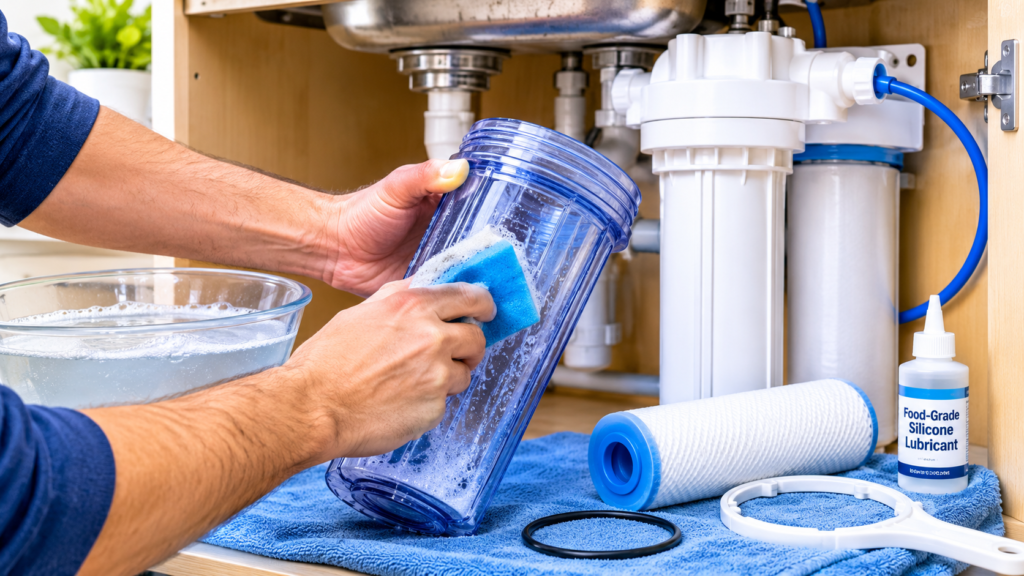
You need a housing wrench, a bucket, mild unscented dish soap, food-grade silicone lubricant, a spare O-ring and your replacement cartridge. Buy the spare O-ring before you open the housing, not after, because a cracked seal found mid-job means no filtered water until the part arrives.
A filter housing is the pressure-rated plastic canister that holds a filter cartridge, used to force incoming water through the filter media. An O-ring is a rubber ring seated where the housing meets its head, used to seal that joint against leaks.
- Housing wrench: usually supplied with the system. It grips the housing without crushing it.
- Bucket and towel: the housing holds water that will spill when you open it.
- Use mild unscented dish soap along with a soft sponge or bottle brush to clean the housing walls and threads.
- Food-grade silicone lubricant: keeps the O-ring flexible and sealing.
- Spare O-ring and replacement cartridge: match both to your exact model..
If you run a dual-stage system, you have two housings. Repeat every step for each one.
How do you clean an under-sink water filter housing, step by step?
Cleaning takes eight steps: shut off the water, release pressure, open the housing, wash it, check the O-ring, reassemble by hand, test for leaks, then flush. The whole job follows the same sequence as a cartridge change, with washing and sealing checks added.
- Turn the feed valve under the sink clockwise until it stops. Set the bucket and towel under the housing so a dry floor makes leaks easy to spot later.
- Open the filtered-water faucet to release pressure. Leave it open until the flow stops. Pressure left inside the system is a frequent reason a housing refuses to turn.
- Unscrew the housing with the wrench. Turn anticlockwise as you look up at it. Expect some water to spill into the bucket. Lift out the cartridge and note which end faces up. If the cartridge is due, replace it now.
- Wash the housing with warm water and mild unscented dish soap. Scrub the inside walls and the threads with a soft sponge or bottle brush until any slick film is gone. Rinse until no suds remain. Avoid abrasive pads that scratch the plastic.
- Inspect and lubricate the O-ring. Lift the O-ring out of its groove and wipe it clean. Look for cracks, flat spots, or brittleness, and replace it if you see any. Apply a thin coat of food-grade silicone and seat it without twisting.
- Reinstall the cartridge and tighten the housing by hand. Seat the cartridge the way it came out, then screw the housing on until it is snug. Use the wrench for a final snug only if your manual calls for it. Over-tightening deforms the O-ring.
- Reopen the supply slowly and check for leaks. Turn the valve open gradually. Hold a dry paper towel against the housing seam and watch for 5 minutes.
- Flush the system. Run the filtered-water faucet for the time your manual states. Some manufacturers specify several minutes, and some guides call for at least 10 minutes. Sputtering is trapped air.
If you are missing any of the small parts, a spare O-ring set, food-grade silicone lubricant, and a housing wrench are the three items that make this job safe to repeat. A maintenance kit bundles them.
What should you clean a filter housing with, and what should you never use?
Use warm water and mild unscented dish soap on the housing, and skip bleach, solvents, and scented cleaners unless your manual says otherwise. The housing holds water you will drink, so any cleaner residue ends up in your glass.
Some filter guides warn against bleach, while others suggest disinfectant wipes. Manufacturers differ, so your model’s manual settles the question.
| Part | Safe to use | Never use | Replace when |
|---|---|---|---|
| Housing | Warm water, mild unscented dish soap, soft sponge or bottle brush | Solvents, scented cleaners, abrasive pads, bleach unless the manual allows it | Cracked, white stress lines near threads, deformed threads, drips after a new O-ring |
| O-ring | Damp cloth wipe, food-grade silicone lubricant | Petroleum jelly, oils, harsh cleaners | Cracked, flattened or brittle, or leaking after being reseated |
| Cartridge | Nothing. Replace on schedule | Acid, bleach or scrubbing | At the manufacturer’s interval, or earlier if flow drops or taste returns |
| RO membrane housing | The manufacturer’s own cleaning or sanitizing instructions | Homemade chemical mixes | Per manufacturer. Published lifespans vary |
Save or screenshot this Housing Care Card (1 of 3). It covers what is safe to use on each part of your filter system.
Do you need to sanitize the filter housing?
Washing removes visible film, while sanitizing is a separate step, and only your manual can say whether your system needs it. Never improvise a sanitizer concentration.
Some reverse osmosis service kits include a sanitizer packet with its own instructions. Follow those exactly, then rinse and flush as directed.
If your manual has no sanitizing step, washing at each cartridge change is the manufacturer-sanctioned routine.
How often should you clean an under-sink filter housing?
Wash the housing every time you change the cartridge, and inspect it for leaks and dampness every 3 to 6 months. Cartridges typically need replacing every 6 to 12 months, so most households open the housing once or twice a year.
Water quality, household use, and cartridge type change the interval. Our guide on how long an under-sink water filter lasts lasts covers each factor.
If your system has no indicator light, the EPA’s guide to maintaining a water filter says to track days or gallons since the last change and set your own reminder.
| Task | How often | What to check |
|---|---|---|
| Leak and dampness inspection | Every 3 to 6 months | Dry towel under fittings and housing seams |
| Open and wash housing | At each cartridge change | Film on walls, debris in threads |
| O-ring check and lubrication | Every time the housing is opened | Cracks, flat spots, brittleness |
| Cartridge replacement | Typically every 6 to 12 months, or per manual | Reduced flow, returning taste or odor |
| Flush after long idle period | If unused for several weeks | Clear, steady flow before drinking |
| Housing replacement | When failure signs appear | Cracks, deformed threads, persistent drips |
Save or screenshot this Housing Care Card (2 of 3). It covers when to inspect, wash and replace each part.
Want all three parts on one printable page, plus a reminder timed to your next cartridge change? Filter Expert Hub can send you the full Housing Care Card.
How do you make a filter housing last longer?
Five habits extend housing life: on-time cartridge changes, silicone-only lubricant, hand-tight assembly, cold water only and a flush after idle periods. A cartridge that is past its life can still pass water while filtering poorly, so flow alone never proves the system is working.
Change cartridges on time
The EPA states that filter cartridges wear out and lose effectiveness with use, and that certified filters only protect you when maintained properly. Follow the manufacturer’s interval and use cartridges made for your model.
Use silicone lubricant, never petroleum jelly
Food-grade silicone keeps rubber O-rings flexible. Petroleum-based products such as petroleum jelly can swell and degrade rubber seals, which is why silicone is the standard choice. The seal fails long before the plastic housing does.
Tighten by hand
Over-tightening is a common cause of leaks, because it squeezes the O-ring out of shape and stresses the threads. A snug hand-tight fit seals properly on a healthy O-ring.
Keep hot water away
The EPA warns that hot water can damage a filter. Feed the system from the cold line only.
Flush after the system sits idle
If nobody has used the filtered tap for several weeks, flush it before drinking. The EPA also advises letting water that has sat in pipes run separately from the filter, which spares the cartridge.
How long do water filter housings last?
No fixed lifespan applies, and your manual’s warranty period is the only manufacturer-backed number you can rely on. Manufacturers generally publish warranties rather than guaranteed service lives.
A housing kept on cold water, tightened by hand and sealed with a healthy O-ring can outlast many cartridge changes. Wear shows up in specific ways.
What signs mean the housing itself needs replacing?
Replace the housing, not just the O-ring, when you see any of these:
- Cracks, or white stress lines near the threads
- Threads that no longer grip or look deformed
- A drip that continues after you fit a new, lubricated O-ring
- Film or discoloration that survives a full wash
Can you clean and reuse a water filter cartridge?
Usually not. Cleaning cannot restore a saturated cartridge to full capacity. Some synthetic sediment cartridges tolerate a cold-water rinse when the manufacturer allows it, and extra life from rinsing is short.
Carbon blocks and reverse osmosis membranes generally need replacing rather than scrubbing or soaking, unless the manufacturer gives cleaning instructions. Aging media can also grow bacteria, which is another reason to replace cartridges on schedule
What are the most common mistakes, and how do you troubleshoot problems?
Most problems after cleaning trace back to the O-ring or to over-tightening, not to a faulty housing. Five mistakes cause the majority of post-cleaning trouble.
- Over-tightening the housing with the wrench
- Pinching or twisting the O-ring while reseating it
- Opening the housing before the pressure is released
- Using petroleum jelly instead of food-grade silicone
- Skipping the flush
| Symptom | Likely cause | Fix |
|---|---|---|
| Drip at the housing seam | Twisted, dry or cracked O-ring | Shut off water, open, reseat or replace the O-ring, lubricate with silicone, retighten by hand |
| Housing will not turn | Pressure still in the system, or over-tightening | Confirm the supply is off, open the filtered tap, then use the housing wrench. No pipe wrench and no heat |
| Slow flow after cleaning | Trapped air, partly closed feed valve, saturated cartridge | Fully open the valve, flush again, replace the cartridge if due |
| Musty smell or slick film | Film left in the housing, overdue cartridge | Wash the housing again and replace the cartridge |
| Spitting or sputtering | Air trapped after the change | Keep flushing until the flow runs steady |
| Cracked housing | Age, stress or over-tightening | Replace the housing |
Save or screenshot this Housing Care Card (3 of 3). It covers what each leak, flow or smell symptom means and what to do.
If water still trickles after a long flush, work through the causes in our guide to slow flow in under-sink filters.
When should you call a plumber or replace the system?
Call a plumber when the feed valve will not fully close, water sprays from a cracked housing, or a leak persists after a correctly seated new O-ring. If water is spraying, shut off the home’s main supply first.
Also call a professional if corroded fittings or unfamiliar plumbing make you unsure which line feeds the filter. If you are replacing the whole system or its brackets, our installation walkthrough shows how the parts connect.
This guide is general. Your model’s manual overrides any step here, and the EPA’s guidance says to follow manufacturer instructions exactly.
F Q As
How long do water filter housings last?
No fixed lifespan applies, because manufacturers generally publish a warranty period rather than a guaranteed service life. A housing kept on cold water, tightened by hand, and fitted with a healthy, silicone-lubricated O-ring can outlast many cartridge changes. Replace the housing when you see cracks, deformed threads, or a drip that continues after a new O-ring. Your manual lists the warranty length.
How do you clean a water filter housing?
Shut off the supply valve, open the filtered-water tap to release pressure, and unscrew the housing with its wrench. Remove the cartridge, wash the housing with warm water and mild unscented dish soap, and rinse until no suds remain. Inspect the O-ring and coat it with food-grade silicone. Reassemble hand-tight, reopen the valve slowly, check for leaks, and flush.
How long does an under-sink water filter last?
Reverse osmosis membranes last longer, but published figures vary, so use your manufacturer’s number. If the system has no indicator light, the EPA advises tracking days or gallons since the last change. Our guide onhow long an under-sink filter lasts goes deeper.
Can a water filter be cleaned and reused?
Sometimes, but it is rarely worth the effort. A synthetic sediment cartridge may tolerate a cold-water rinse if the manufacturer allows it, while carbon blocks and reverse osmosis membranes generally need replacing rather than scrubbing. Cleaning cannot restore a saturated cartridge to full capacity, and ageing media can grow bacteria, so replace cartridges on schedule and follow your manual.
Can you clean a filter housing with vinegar?
Diluted distilled white vinegar can loosen mineral film on a plastic housing, but warm water and mild unscented soap handle most dirt. Rinse until no vinegar smell remains, because residue ends up in your drinking water. Check your manual first, since some manufacturers specify soap only, and strong acids can damage seals and plastic.
Can you use bleach on a filter housing?
Only if your manufacturer’s manual calls for it. Some filter guides warn against bleach because residue can reach your drinking water or damage components, and some manuals include a specific sanitising step with a named product and amount. Without that instruction, stick to warm water and mild unscented soap, and rinse thoroughly.
How long should you flush after cleaning?
Run the filtered-water faucet for the time your manual states, because manufacturers specify different durations, and some guides call for at least 10 minutes. Expect sputtering from trapped air and, with a new carbon cartridge, possibly black specks of loose carbon. Keep flushing until the water runs clear and steady, with no sputtering.
What to do next
Your housing is clean, so the next question is timing. Check the replacement window in our guide on how long an under-sink water filter lasts, then order the cartridge that matches your model before the date arrives.
If flow is still weak after a flush, the slow-flow troubleshooting guide walks through the remaining causes.
If a cracked housing or worn fittings mean replacing parts, the under-sink installation walkthrough shows how everything connects.