
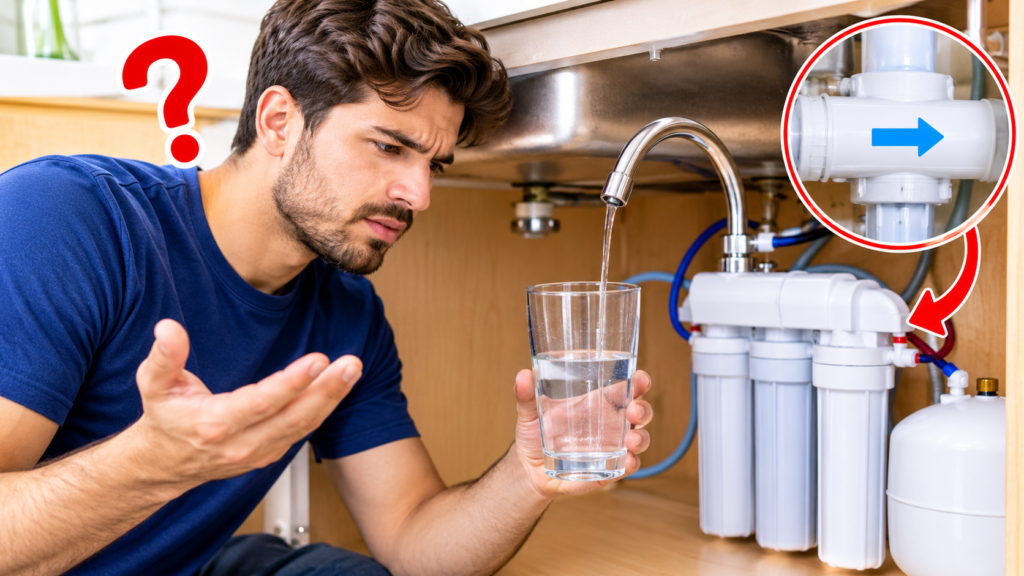
Introduction
Why Is My Under-Sink Water Filter Flow Slow After Installation? You just finished installing the filter, opened the faucet, and got a trickle or a sputtering mess. That’s frustrating, and it almost always points to a small, fixable issue rather than a bad filter.
This guide shows you the causes in order of likelihood and gives you a 7-step checklist, a troubleshooting table, and a bucket test to measure your actual flow.
Table of Contents
Quick Answer: Under-sink filter flow runs slow after installation mostly because of trapped air, an unflushed cartridge, a partly closed shut-off valve, a backwards or kinked connection, or a cartridge that restricts flow by design. Flush the cartridge per the manual, bleed air, open the valve fully, and check the flow arrow. Most of these checks take about 10 minutes in total
What You Need to Know
- A brand-new filter is usually unclogged. Slow flow on day one usually comes from air, a valve, or the connections.
- Flush the cartridge before judging flow. Manufacturers set the flush time, so follow your manual.
- Check three things first: the shut-off valve fully open, the flow-direction arrow correct, and the tubing not kinked.
- Some systems are slow by design: tight-micron carbon blocks, reverse osmosis, and dedicated filter faucets.
Why is water flow slow after installing an under-sink filter?
Slow flow after installation comes from five common causes: trapped air, an unflushed cartridge, a partly closed valve, a reversed or kinked connection, or a cartridge that restricts flow by design. Install problems are far more likely than clogging on a new filter, because clogging builds up over weeks or months of use.
Here is the counterintuitive part. Many people blame the filter media itself, but air trapped inside the housing and cartridge is a frequent culprit reported by owners. The water has to push the air out before it can flow freely
Is some flow reduction normal with an under-sink filter?
Yes, some reduction is normal, because any filter adds resistance. The finer the filtration, the more the cartridge slows water, so a certified, tight-filtration cartridge will flow slower than a coarse sediment filter. Your manual lists the rated flow for your cartridge.
Cartridge type and micron rating
If you swapped a coarse cartridge for a fine one, a slower stream is expected. Please compare your result to the rated flow in the manual before concluding that there is an issue.
RO and dual-stage systems
Reverse osmosis (RO) is a filtration method that pushes water through a very fine membrane and is used to remove dissolved substances. RO systems typically deliver water to a small dedicated faucet, which is slower than your main tap by design.
Dual-stage systems add a second cartridge, which adds resistance too. Our comparison ofsingle-stage versus dual-stage water filters explains how stage count affects flow..
How do I fix slow flow after installing an under-sink filter?
Work through these seven checks in order, from quickest to most involved. Start with the flush and the shut-off valve, because they fix most new-install cases. Keep a towel and a shallow container under the connections.
.
- Flush the cartridge per the manual. Run water through the filter for the time your manufacturer specifies. Instructions vary by product, so use the figure in your manual rather than a generic number. Run it into a container, not down the sink, if the manual warns about carbon fines (black specks).
- Bleed trapped air. Open the dedicated faucet or main tap fully and let it sputter until the stream turns steady. Air pockets usually clear within the flush. If sputtering continues well past the manual’s flush time, move to step 3.
- Open the shut-off valve fully. A quarter-turn valve should sit parallel to the pipe when open. A valve left half-open cuts flow to a trickle. Turn the handle until it stops, then retest.
- Verify the flow-direction arrow. Each cartridge or housing has an IN and OUT marking or an arrow. If it points the wrong way, shut off the water, release pressure, and reverse the connections.
- Inspect tubing for kinks and sizing. Trace every tube from the shutoff valve to the filter and then to the faucet. A bent tube restricts flow like a pinched garden hose. Straighten it, or reroute with a gentler curve.
- . Some cartridges ship in plastic wrap that blocks water entirely. Remove the wrap and twist the cartridge until it locks. For general installation habits, see our guide to installing a water filter (written for RVs, but the connection basics carry over).
- . Unscrew the aerator at the tip of the faucet, rinse out debris, and reinstall. A clogged aerator makes a tap seem low even when the filter is fine.
If flow is still weak after step 7, jump to the troubleshooting table below.
How long should I run water after changing a filter?
Run water for the flush time your manufacturer specifies. Flush times differ by product, so the manual beats any general rule. Some cartridges need only a short flush, while others, such as carbon-based or RO-related cartridges, may call for longer.
Flushing also clears air and loose carbon dust, which is why the water can look cloudy or gray at first. That is usually temporary. : cartridge manufacturer’s official installation manual,
Troubleshooting Table: Symptom, Cause, Test, Fix
Use this table to match what you see to the likely cause. A sputtering stream points to air, while a steady-but-weak stream points to restriction. Each test takes about a minute.
| Symptom | Likely cause | 60-second test | Fix |
|---|---|---|---|
| Sputtering, spitting air | Trapped air in housing | Open the faucet fully and listen for gurgling | Keep flushing until the stream is steady |
| Weak but steady stream from the first use | Shut-off valve partly closed | Check that the handle is parallel to the pipe | Open the valve fully |
| Near-zero flow | Cartridge wrap left on or not seated | Shut off water, remove the cartridge, inspect | Remove wrap, reseat until it locks |
| Slow flow, tubing looks bent | Kinked or crushed tubing | Trace each tube by hand | Straighten or reroute the tube |
| Slow only at the filter faucet | Dedicated faucet or RO design | Compare filter faucet to the main tap | Normal by design; confirm with the manual’s rated flow |
| Slow at every tap, filter or not | House pressure or supply issue | Run another tap far from the filter | Contact a plumber or your water utility |
| Slow from the main faucet only | Clogged aerator | Unscrew the aerator and rinse it | Clean or replace the aerator |
| Cloudy or gray water early on | Carbon dust in a new cartridge | Let a glass sit and watch it clear | Continue flushing |
Save or screenshot this troubleshooting table: it covers the most common causes of slow flow after a new under-sink filter installation.
Get the printable version: join the Filter Expert Hub newsletter, and we’ll send you the Slow Flow Troubleshooting Checklist, plus practical filter guides for your home.
How do I measure my flow rate? (Bucket Test)
The bucket test is a simple way to measure flow in gallons per minute (GPM). GPM equals 60 divided by the seconds it takes to fill one gallon. It turns “feels slow” into a number you can compare with the manual.
- Grab a 1-gallon container and a timer. A milk jug works.
- Stop when the container is full. Note the seconds.
- Divide 60 by that number. For example, 30 seconds equals 2 GPM, and 60 seconds equals 1 GPM.
- Compare to your manual’s rated flow. A reading near the rating means the filter is working as designed..
Run the same test at a tap that bypasses the filter. The difference shows how much the filter itself restricts flow.
Is the problem the filter or my home’s water pressure?
To find out, compare filtered and unfiltered taps. If every tap in the house is weak, the filter is not the cause. Low pressure often comes from the supply, a partly closed main valve, or the plumbing itself.
Use this quick decision tree:
- Weak at the filtered faucet only? Go back to the checklist and the flow-direction check.
- Weak at all taps? Check your main shut-off valve, then contact your water utility or a plumber.
- Was it weak before you installed the filter? The filter is not the cause.
What if the problem started with a new tap or faucet?
A new faucet can also feel low if its aerator is clogged with debris from installation or if the supply lines are kinked behind the sink. Unscrew the aerator, rinse it, and check the supply lines for bends. If you installed both a faucet and a filter, test each one separately.
Which filter setups slow flow the most?
Systems with more stages, finer filtration, or a membrane slow flow the most. RO systems and multi-stage setups restrict flow more than a single coarse cartridge. That is the trade-off for the finer filtration they provide.
If you’re still choosing a system, read our breakdown of single-stage versus dual-stage filters so you know what flow to expect before you buy.
Common Mistakes That Cause Slow Flow
These are the mistakes owners report most often. Skipping the flush is the most common mistake reported in owner forums. Most are quick to fix.
- Skipping or cutting short the flush.
- Leaving the shut-off valve half open.
- Reversing the IN and OUT connections.
- Leaving the shipping wrap on the cartridge.
- Over-bending tubing to fit it into a tight cabinet.
- Judging flow at the filter faucet against the main tap without checking the manual’s rated flow.
When should I replace the cartridge or call a plumber?
Replace the cartridge when flow drops gradually over weeks or months, or when the manufacturer’s replacement interval passes. Call a plumber if the flow stays low after the full checklist or if it was low before the install. That points to a plumbing or supply issue, not the filter.
Our guide on how often to replace a water filter covers replacement logic (written for RVs, but the interval reasoning applies). Check your own manual for exact intervals.
FAQs
Why is my water pressure low after installing a water filter?
The most common causes are trapped air, an unflushed cartridge, a partly closed shut-off valve, reversed flow direction, or kinked tubing. A new filter is rarely clogged. Flush the cartridge per the manual first, then check the valve, the flow arrow, and the tubing.
How to fix slow water flow in the sink?
Flush the filter, bleed trapped air, open the shut-off valve fully, check the flow-direction arrow, inspect tubing for kinks, confirm the cartridge is seated and unwrapped, and clean the faucet aerator. If every tap is slow, the cause is household pressure, not the filter.
Why is my water pressure low after installing a new tap?
A new tap often has a clogged aerator from installation debris or a kinked supply line behind the sink. Unscrew the aerator, rinse it, and check the supply lines for bends. If the tap is also connected to a filter, test the tap alone.
How long should I let water run after changing the filter?
Run water for the flush time your manufacturer specifies. Times vary by cartridge type, and carbon cartridges may release loose dust at first. Follow your manual, and keep flushing until the water runs clear and steady.
Is some flow reduction normal with an under-sink filter?
Yes. Any filter adds resistance, and finer filtration slows water more. RO systems and dedicated filter faucets are slower by design. Compare your bucket-test result to the rated flow in your manual to know whether your flow is normal.
How do I know if low flow is the filter or my house pressure?
Run another tap that bypasses the filter. If that tap is also weak, the problem is household pressure or supply, and the filter is not responsible. If only the filtered faucet is weak, work through the 7-step checklist.
What to Do Next
- Choosing or upgrading a system? Read about single-stage versus dual-stage water filters before you buy.
- Planning cartridge swaps? See how often to replace a filter.
- Want an under-sink install guide?