
Introduction
Single vs Dual Stage Under Sink Filters: The Real Difference You’re comparing two under-sink filters on a product page, one labeled 1-stage and the other 2-stage for noticeably more money, and nothing on either page explains what the extra stage buys you. The difference is narrower and more specific than the labels suggest, and this article ends with a one-page chart that matches the right setup to your water.
Table of Contents
Quick Answer:A single-stage under-sink water filter runs water through one cartridge, usually carbon, to improve taste and reduce chlorine. A dual-stage filter uses two cartridges in sequence, typically sediment first and carbon second, so the carbon stays unclogged longer. Neither reduces dissolved solids; that requires reverse osmosis.
What You Need to Know
- A single-stage filter has one cartridge. A dual-stage filter has two cartridges in sequence, usually sediment then carbon.
- The second stage protects the carbon from clogging. It does not add a new category of contaminant removal.
- Setup does not reduce dissolved solids, and standard sediment-plus-carbon usually does not reduce fluoride. Reverse osmosis (RO) does that job.
- The certification on the cartridge (NSF/ANSI 42, 53 or 58) matters more than the stage count on the box.
- Please review your water report (city) or consider obtaining a lab test (well) prior to making any purchases.
What Is the Difference Between Single-Stage and Dual-Stage Under Sink Filters?
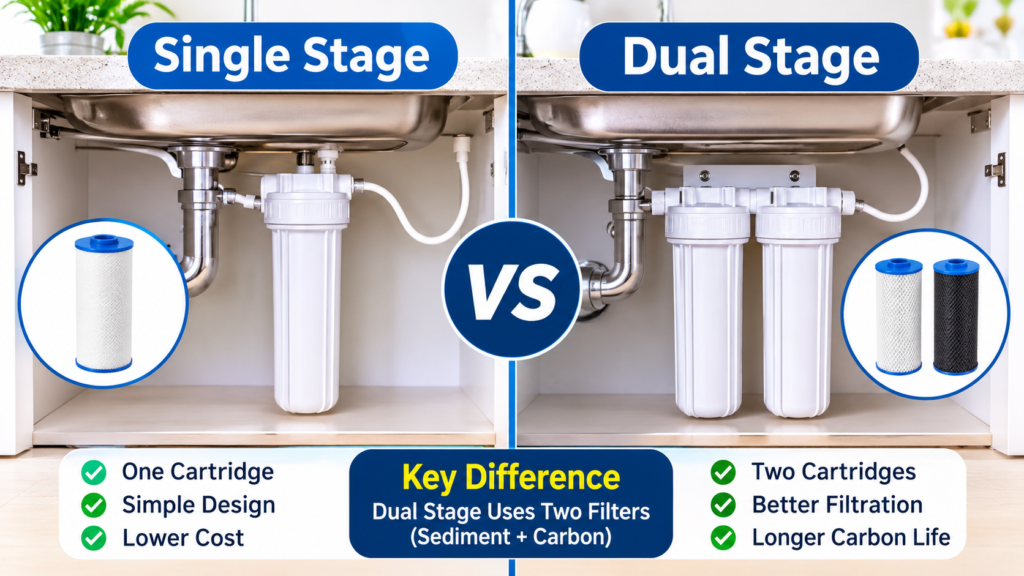
A single-stage filter puts all the work on one cartridge, while a dual-stage filter splits the work across two cartridges in a row. The second stage changes how the work is divided, not which contaminants the system can handle.
A single-stage under-sink water filter is one housing holding one cartridge, used to improve taste and reduce chlorine or sediment depending on the media inside. A dual-stage under-sink water filter is two housings plumbed in sequence, used to give sediment capture and chemical reduction their own cartridges.
| Single-Stage | Dual-Stage | |
|---|---|---|
| Cartridges | 1 | 2 |
| Typical media | Carbon block (or sediment) | Sediment, then carbon |
| Main benefit | Simplicity, one cartridge to track | Carbon protected from clogging |
What Is a “Stage,” and What Isn’t It?
A stage is one filtration step, one cartridge or treatment medium that water passes through before the next step or the faucet. Stage count says nothing about quality on its own.
Here is the counterintuitive part: the first stage of a dual-stage filter exists to protect the second stage, not to make your water noticeably cleaner. Sediment cartridges catch grit, rust flecks and scale so the carbon behind them can spend its capacity on chlorine and taste.
That also means a single-stage filter is not automatically the weaker choice. Many single-carbon blocks are built to reduce some sediment along with chlorine, which is why one cartridge can be plenty on clear city water.
NSF/ANSI 42 covers aesthetic effects such as chlorine taste and odour. NSF/ANSI 53 covers health-related contaminants such as lead. Those standards apply to specific cartridges and systems, not to the number of stages.
How Does a Dual-Stage Under Sink Filter Work?
A dual-stage filter sends water through a sediment cartridge first and a carbon cartridge second, so grit never reaches the carbon. Dual-stage does not always mean sediment plus carbon, so read the cartridge labels, not just the stage count.
Stage 1: The sediment pre-filter
A sediment cartridge is a depth filter, used to trap particles such as sand, rust and scale. Its rating is in microns, one-millionth of a metre. A 5-micron cartridge is a common choice, and a 1-micron cartridge catches finer particles but loads faster.
Stage 2: The carbon block
Activated carbon is a porous material used to reduce chlorine, bad taste, odour and, on certified models, some organic chemicals. Chloramine is harder for standard carbon to reduce than free chlorine, so confirm the spec sheet if your utility uses it.
Other dual-stage pairings
Some dual-stage units pair two carbon cartridges for more contact time. Others pair carbon with a lead-reduction cartridge. The housing count is the same, but the capability is not.
Single-Stage vs Dual-Stage: Side by Side
The two setups differ mostly in maintenance, flow and cabinet space, not in the range of contaminants they can remove. Use this table to compare them on the points that affect daily use.
| Feature | Single-Stage | Dual-Stage |
|---|---|---|
| What it handles | Taste, odor, chlorine, and some sediment depending on the cartridge | The same, with sediment captured before the carbon |
| What it does not handle | Dissolved solids, fluoride, and anything the cartridge isn’t certified for | Dissolved solids, fluoride, and anything the cartridges aren’t certified for |
| Flow and pressure | Less resistance, generally faster flow | More resistance, and flow falls as the sediment stage loads |
| Cartridge tracking | One replacement schedule | Two schedules, often different |
| Cabinet space | One housing | Two housings side by side, plus clearance below each to unscrew it |
| Cost structure | Lower upfront, one cartridge per cycle | Higher upfront, a cheaper pre-filter changed more often can extend carbon life |
| Best for | Clear city water with a taste or chlorine complaint | Older plumbing, visible particles, or well-supplied water as a starting point |
When Is a Single-Stage Filter Enough, and When Is Dual-Stage Worth It?
Single-stage is enough when your city water is generally clear and chlorine taste or odor is your only complaint. Dual-stage earns its extra cost when particles are part of the problem.
Choose single-stage if:
- Your water report shows no specific contaminant you need to remove.
- You want one cartridge to track and replace.
- Cabinet space is tight.
Choose dual-stage if:
- Your water carries rust flecks, grit, or cloudiness, common with older pipes.
- A single cartridge has clogged quickly in the past.
- You want a cheap pre-filter to take the loading so the pricier carbon cartridge lasts.
Is a 2-Stage Water Filter Enough?
A 2-stage filter is enough if your goal is chlorine taste, odor, and sediment reduction. It is not enough for dissolved contaminants such as fluoride or high total dissolved solids (TDS). “Enough” depends on what you need removed, not on how many stages you have.
TDS is the total amount of dissolved minerals, salts, and metals in water, measured in parts per million. Standard sediment and carbon stages don’t meaningfully reduce it. If your complaint is a salty or mineral taste, extra carbon stages won’t fix it.
Single-Stage vs Dual-Stage vs Reverse Osmosis: Where Is the Real Line?
The meaningful jump is from a filter to reverse osmosis, not from one stage to two. RO is the category that reduces dissolved contaminants; adding more sediment or carbon stages does not.
| Single-Stage | Dual-Stage | Reverse Osmosis | |
|---|---|---|---|
| Reduces dissolved solids | No | No | Yes |
| Typical cartridges | 1 | 2 | Several, plus a membrane |
| Wastewater | None | None | Yes, during filtering |
| Flow | Fastest | Fast | Slower, often paired with a storage tank |
Which Under-Sink Setup Do You Need? A Four-Step Decision
You can pick the right setup in four steps, and the first two cost nothing. Do them in order.
- Get your water quality data. City customers can read the annual Consumer Confidence Report. According to the EPA’s Consumer Confidence Report page, community, water systems deliver it each year. Well, owners need a lab test because no report exists.
- Name your actual problem. Pick one: chlorine taste, rust or grit, lead concern, or fluoride and salty taste. Write it down before shopping.
- Match the setup with the chart below. Find your situation in the left column and read across.
- Check the certification on the cartridge. Look for NSF/ANSI 42, 53, or 58 listed for your specific concern, and confirm it names the cartridge model you’re buy
| Your situation | Setup that fits | What it will NOT fix |
|---|---|---|
| City water, chlorine taste or odor only | Single-stage carbon block (NSF/ANSI 42) | Dissolved solids, lead (unless also certified to 53) |
| City water, taste plus rust flecks or cloudiness | Dual-stage: sediment, then carbon | Dissolved solids, fluoride |
| Lead concern, confirmed by a test | Cartridge certified to NSF/ANSI 53 for lead, single or dual | Anything beyond the certified claims |
| Fluoride, salty or mineral taste, high TDS | Reverse osmosis (NSF/ANSI 58) | Nothing a membrane system can’t reach, but you’ll deal with wastewater and slower flow |
| Private well | Lab test first, then match to results. Sediment plus carbon is only a starting point | Bacteria. Sediment and carbon stages do not disinfect |
Save or screenshot this Under-Sink Setup Decision Chart. It covers which setup matches your water source and complaint, so you can check it at the store or on the checkout page.
Want this chart as a one-page printable, plus a reminder to change your cartridges on time? Join the Filter Expert Hub newsletter and we’ll send it.
Want Fluoride or Dissolved Solids Out of Your Water?
Standard sediment-plus-carbon setups usually don’t reduce fluoride, so if fluoride is your goal, a different technology is the next question to answer. Fluoride reduction generally requires RO or specialty media, not extra carbon stages.
Our breakdown of whether under-sink water filters remove fluoride covers which technologies work and what to check on a spec sheet.
What Certifications Should You Check on an Under-Sink Filter?
Check for the NSF/ANSI standard that matches the contaminant you want removed, and confirm it applies to the exact cartridge. A high stage count without the matching certification is not evidence the filter removes anything in particular.
| Standard | Covers | Use it to verify |
|---|---|---|
| NSF/ANSI 42 | Aesthetic effects | Chlorine taste and odor reduction |
| NSF/ANSI 53 | Health effects | Lead and other health-related contaminants |
| NSF/ANSI 58 | Reverse osmosis systems | Dissolved solids reduction |
The standards are published byNSF, , and the Water Quality Association is a trade group that also covers point-of-use treatment.
What Are the Most Common Mistakes, and How Do You Troubleshoot Problems?
The most frequent mistake is buying by stage count instead of by the contaminant you need removed. Most problems after installation trace back to a clogged sediment stage or an exhausted carbon cartridge.
Other common mistakes:
- Assuming dual-stage means lead removal. It only does if a cartridge is certified for lead.
- Installing cartridges in the wrong order. Sediment goes first, carbon second.
- Skipping the manufacturer’s flushing instructions on new carbon cartridges, which leaves loose carbon fines in the first glasses of water.
- Stretching a cartridge past its rated gallons or months.
| Symptom | Likely cause | Fix |
|---|---|---|
| Weak flow from the filtered tap | Loaded sediment cartridge | Replace the sediment stage |
| Chlorine taste returns | Exhausted carbon | Replace the carbon cartridge |
| Cloudy water after a change | Trapped air | Run the tap until it clears |
| Drip at a housing | Misseated O-ring | Depressurize, reseat and lubricate the O-ring per the manual |
When Should You Test Your Water or Call a Professional?
TTest your water first if you are on a private well, suspect lead plumbing, or have received a boil-water advisory. A filter certified only for taste and odor (NSF/ANSI 42) makes no health claim and does not disinfect water.
Call a licensed plumber if you aren’t comfortable cutting into the cold line or the faucet shank. Contact your utility for boil-water advisories, because no under-sink carbon filter replaces boiling in those cases
FAQs
What is the best type of under-sink water filter?
The best type of under-sink water filter is the one matched to your water report and your complaint. Single-stage carbon suits chlorine taste on good city water, dual-stage adds sediment protection for older pipes or particulates, and reverse osmosis suits dissolved contaminants such as fluoride or high TDS. Choose cartridges certified under NSF/ANSI 42, 53, or 58 for your specific claim.
What are the differences between a 1-stage and a 2-stage water filter?
A 1-stage filter uses one cartridge, usually carbon, for taste and chlorine. A 2-stage filter adds a second cartridge, typically a sediment pre-filter, so particles are caught before the carbon. The result is longer-lasting carbon and steadier flow, not removal of dissolved solids. Two stages also mean two housings under the sink and two cartridges to replace.
Which is the best undersink water filter?
No single filter is best for everyone, so rank candidates on four criteria: certification for your contaminant (NSF/ANSI 42, 53, or 58), cartridge availability and replacement cost, cabinet space, and how easy the cartridges are to change. A filter that fails the first criterion is the wrong filter regardless of stage count or price.
Is a 2-stage water filter enough?
A 2-stage filter is enough if you want chlorine taste, odor, and sediment reduction from municipal water. It is not enough for dissolved solids, fluoride, or any health-related contaminant its cartridges aren’t certified to reduce. Check your water report first, then compare the contaminants you need removed against the certifications listed on each cartridge.
Does a dual-stage filter remove lead?
Only if one of its cartridges is certified for lead reduction under NSF/ANSI 53. A sediment-plus-carbon pair without that certification should not be relied on for lead. If a test confirms lead in your water, buy a cartridge whose listing names lead and use it as directed, then retest.
How often do you replace under-sink filter cartridges?
Follow the schedule printed for your specific model, which is set by gallons or months. Sediment cartridges often need replacing sooner because they trap particles, and a drop in flow is the usual signal. Replace carbon cartridges when taste or odor returns or when rated capacity is reached, whichever comes first. Don’t stretch one past its rating.
Does a dual-stage filter reduce water pressure?
A second cartridge adds resistance, so a dual-stage setup can deliver slightly less flow than a single-stage one at the same faucet, and flow falls further as cartridges load with particles. A clogged sediment stage is the most common cause of low flow, and replacing it usually restores pressure.
What to Do Next
Your next step depends on what your water report showed.
- If fluoride or a salty taste is your concern, read whether under-sink water filters remove fluoride before you buy.
- If you want filtered water at every tap, see how to install a whole-house water filter.