
Introduction
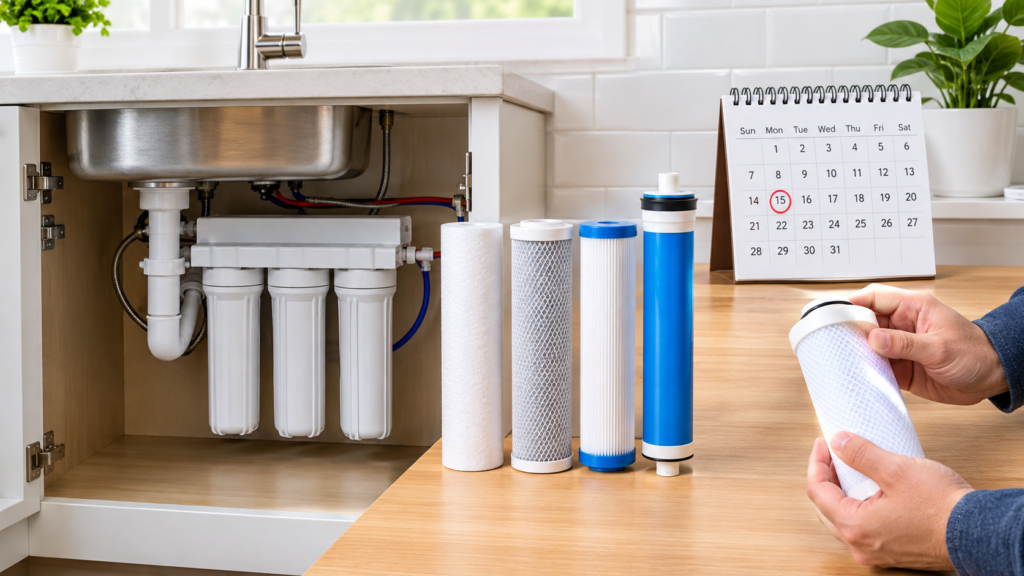
How Long Does an Under-Sink Water Filter Cartridge Last? The indicator light is on, or your water tastes a little flat, and you can’t remember when you last changed the cartridge under your sink. Nothing is wrong yet: most cartridges follow a predictable schedule, and you can work out yours in about two minutes.
Table of Contents
Quick Answer:Most under-sink water filter cartridges last 6 to 12 months. Two limits apply, whichever arrives first: a calendar limit and a rated capacity in gallons. Reverse osmosis membranes run on a separate schedule of about 2 to 5 years. Your manufacturer’s spec overrides all of these.
What You Need to Know
- Sediment, carbon, and multi-stage cartridges are typically changed every 6 to 12 months.
- Every cartridge has two clocks, time and gallons. The first one to run out sets your date.
- Taste is an unreliable alarm. Some contaminants, like lead, have no taste or smell.
- Reverse osmosis membranes and specialty stages follow their own, longer schedules.
- The chart and the five-step calculation below give you a personal replacement date.
This guide is based on manufacturer documentation and published standards, not hands-on testing.
How long does an under-sink water filter cartridge last?
Most residential cartridges last 6 to 12 months. A cartridge is finished when it reaches either its calendar limit or its rated gallons, whichever comes first.
Filter makers and service companies agree on the baseline. The Water People, an Australian filtered-water service company, lists 6 to 12 months for homes and 4 to 6 months for commercial use. Greenfield Water Solutions, a filter retailer in Idaho, recommends 8 to 12 months.
Replacement interval chart by cartridge type
| Stage | Typical interval | Rated capacity (gallons) | What shortens it | Source |
|---|---|---|---|---|
| Sediment pre-filter | 6–12 months | [VERIFY: manufacturer spec sheet] | Sandy, rusty or cloudy water; private wells; old pipes | Tappwater; The Water People |
| Activated carbon (block or granular) | 6–12 months; one retailer says 8–12 | [VERIFY: manufacturer spec sheet] | High chlorine levels; heavy daily use | Tappwater; Greenfield Water Solutions |
| Multi-stage all-in-one cartridge | 6–12 months | [VERIFY: manufacturer spec sheet] | Same factors as sediment and carbon | Tappwater |
| Reverse osmosis membrane | About 2–5 years; one service company says about 2 | Not applicable | Poor feed water; skipped pre-filter changes | Tappwater; The Water People |
| Remineralization or alkaline stage | [VERIFY: one service company cites about 4 years; confirm with manufacturer] | [VERIFY] | Heavy use | The Water People |
| UV lamp | [VERIFY: check the lamp’s rated hours] | Not applicable | Frequent on-off cycling | Manufacturer |
| Commercial or office use | 4–6 months | [VERIFY] | High daily volume | The Water People |
Please save or take a screenshot of this replacement interval chart, as it offers an in-depth look at every common under-sink stage in one place.
Why do cartridges have both a time limit and a gallon limit?
A time limit guards against aging filter media and idle water. A gallon limit guards against saturation. Your replacement date is whichever of the two arrives first.
Rated capacity is the volume of water a cartridge is designed to treat before its performance drops, used to set the manufacturer’s replacement figure in gallons. You will find it on the cartridge label or the spec sheet.
Certification gives a second reason to follow the rating. NSF/ANSI 42 covers aesthetic effects such as chlorine taste and odor, and NSF/ANSI 53 covers health-related contaminants. A certified performance claim applies to the cartridge as tested, up to its stated capacity..
According to the U.S. Environmental Protection Agency’s
home drinking water filtration fact sheet,proper maintenance is what keeps a drinking water treatment device working as intended.
How do you calculate your replacement date?
divide the rated gallons by the gallons you actually run through the filtered tap, and the rated gallons by the gallons you actually run through the filtered tap, then compare the result with the calendar limit. The earlier of the two dates is your replacement date.
- Find the rated capacity. Read it off the cartridge label or spec sheet. The examples below use a hypothetical 500-gallon cartridge.
- Estimate daily gallons through the filtered tap.Showers, laundry and toilets never touch the cartridge. A light household might use 1.5 gallons a day, and a busy kitchen 4 or more.
- Divide capacity by daily use. Household A: 500 ÷ 1.5 ≈ 333 days, about 11 months. Household B: 500 ÷ 4 = 125 days, about 4 months.
- Find the calendar limit. Assume 6 months for this example, taken from the manufacturer’s spec.
- Pick the earlier date. Household A changes at 6 months because the calendar limit arrives first. Household B changes at about 4 months because the gallons run out first.
The same cartridge gives two different schedules, and Household A throws away unused capacity on purpose. These numbers are illustrative, not statistics for any specific product.
What shortens or extends cartridge life?
Water quality and daily volume decide how fast a cartridge fills. Sediment-heavy water and heavy use shorten life, while a pre-filter and light use extend it.
- Sediment load: sandy, rusty or cloudy water clogs a sediment stage sooner, and a clogged stage passes less water.
- Daily volume: more gallons through the filtered tap mean the rated capacity runs out sooner.
- Disinfectant type: chloramine is harder for ordinary carbon to reduce than chlorine, and catalytic carbon is designed for it. [VERIFY against your manufacturer’s spec.]
- Water source: private well water often carries more sediment than municipal supply.
- Long absences: Tappwater advises flushing the system before drinking if it sat unused for several weeks.
- Upstream protection: a whole-house sediment filter, covered in this whole-house water filter installation guide, can reduce the load on the kitchen cartridge.
How do you know your water filter needs replacing?
Check the date first, then the flow, then the taste. Never rely on taste alone, because some contaminants have no taste or smell.
- Check the install date or indicator. Read the date on the cartridge or cabinet wall or the filter-change indicator. If you can’t find a date, treat the cartridge as overdue. [CONTENT GAP: How to find a cartridge’s age and reset the change indicator
- Check the flow. Water that runs slower from the filtered tap than it used to suggests a clogged cartridge.
- Notice taste and smell. A return of chlorine taste or an odd smell means the carbon stage is likely spent.
- Look for visible sediment. Particles in a clear glass point to a failing sediment stage.
- Test for chlorine. Greenfield Water Solutions suggests chlorine test strips: a positive reading in filtered water means the carbon stage is no longer doing its job.
Lead, for example, has no taste or smell, so a filter can taste fine and still be past its limit. The date is the dependable signal.
What happens if you wait too long?
A spent cartridge still passes water, but it treats less of it. Past its capacity, a filter can look and taste fine while doing little.
Tappwater lists four consequences of overdue cartridges:
Replace now, soon, or wait? A troubleshooting decision tree
Work down the table from the first question and stop at the first “yes.” If the cartridge is past either limit, replace it regardless of how the water tastes.
| Question | If yes | If no |
|---|---|---|
| Is the cartridge past its calendar limit or rated gallons? | Replace now. | Go to the next question. |
| Is flow at the filtered tap noticeably slower than before? | Replace now. | Go to the next question. |
| Has the taste or smell changed, or do you see sediment? | Replace now. | Go to the next question. |
| Is the limit less than one month away? | Order the replacement cartridge. | Wait, and set a calendar reminder. |
| Still slow after changing the cartridge? | Confirm the supply valve is fully open, check the tubing for kinks, and flush the cartridge per the instructions. | Done. |
Common mistakes
- Waiting for the taste to change before replacing a cartridge.
- Replacing the carbon stage but leaving an old sediment pre-filter in place.
- Skipping the flush after installation. Tappwater notes many filters need a few minutes of flushing to clear harmless manufacturing residue.
- Ignoring seals, O-rings, the filter housing, and the tap aerator, all of which Tappwater recommends inspecting regularly.
- Fitting a cartridge not designed for your system. Compatible cartridges keep performance reliable, according to Tappwater.
When do reverse osmosis, remineralization and UV stages need changing?
Reverse osmosis systems run several stages on different clocks. The membrane can last years, while sediment and carbon pre-filters usually change every 6 to 12 months.
Sources disagree on the membrane: Tappwater says about 2 to 5 years, and The Water People says about 2. Use your manufacturer’s figure.
Some systems add a remineralization stage. The Water People cites roughly 4 years for alkalisers, soconfirm with your maker. Our alkaline water filter pros and cons article covers what that stage does.
How do you make cartridges last and never miss a change?
Write the next change date when you will see it the moment you install a cartridge. A date on the cabinet wall removes the guesswork.
- Record the install date and the calculated replacement date on the cartridge or the cabinet.
- Keep one spare cartridge for the stage that changes most often.
- Flush every new cartridge for a few minutes before drinking.
- Flush the system if it has sat unused for several weeks.
- Inspect seals, O-rings, and the housing at each change.
Want this chart as a printable one-page schedule, plus a reminder email when your next change is due? Join the Filter Expert Hub newsletter
When should you call a professional or the manufacturer?
Call for help when the problem is bigger than a cartridge. These intervals are typical, not guaranteed, and your manufacturer’s specs always override this guide.
- Your local utility has issued a boil-water notice.
- The filter housing is cracked or leaking.
- A lab test shows lead or another regulated contaminant. Use a properly certified filter and ask a professional to interpret the results..
What should you read next?
The questions readers ask after this one are how to replace the cartridge, which replacement fits, and what the yearly cost is.
- Running a filter in a motorhome too? The same two-clock logic applies, and our guide to how often to replace an RV water filter shows how it plays out there.
FAQs
How often should you replace an under-sink water filter?
Replace an under-sink water filter cartridge every 6 to 12 months in most homes, or sooner if it reaches its rated gallon capacity first. Filter companies cite 4 to 6 months for commercial use, and some recommend 8 to 12 months for homes. Reverse osmosis membranes are the exception, at roughly 2 to 5 years. Always follow your manufacturer’s stated interval.
How long should a water filter cartridge last?
An under-sink water filter cartridge should last until it reaches either its calendar limit, usually 6 to 12 months, or its rated gallon capacity, whichever comes first. This guide covers under-sink systems only: pitcher, refrigerator, and whole-house cartridges follow different clocks, so check the label for your type. Heavy use and poor water quality shorten life.
What is the typical lifespan of a water filter cartridge?
The typical lifespan of an under-sink water filter cartridge is 6 to 12 months for sediment, carbon, and multi-stage types, based on figures from filter makers and service companies. A reverse osmosis membrane lasts longer, often 2 to 5 years. Actual lifespan depends on household water use, incoming water quality, and the cartridge’s rated gallons, so treat these numbers as ranges, not guarantees.
How do I know if my water filter needs replacing?
Check four things: the install date or indicator, slower flow at the filtered tap, a return of chlorine taste or odor, and visible sediment. Treat the date as the main signal, because some contaminants, like lead, have no taste or smell. A chlorine test strip reading in filtered water also suggests the carbon stage is spent.
Does an unused water filter expire?
An installed cartridge still follows its calendar limit even if you use little water, because the limit covers aging media as well as capacity. A sealed spare may carry its own shelf life, so check the manufacturer’s packaging. If the system has sat idle for several weeks, flush it for a few minutes before drinking from it.
Do you change all under-sink filter stages at the same time?
No. Each stage runs on its own clock. Sediment and carbon cartridges are typically changed every 6 to 12 months, while a reverse osmosis membrane often lasts about 2 to 5 years, and remineralization or UV stages follow separate manufacturer intervals. Replace each stage on its own schedule, and write every date on the system so none is missed.
Why is water flow slow after changing a filter cartridge?
Slow flow after a new cartridge is rarely the cartridge itself. Flush the new cartridge for a few minutes as the instructions direct, confirm the water-supply valve is fully open, and check the tubing for kinks. If the filtered tap stays slow after those checks, contact the cartridge manufacturer to confirm the cartridge matches your system.