
Introduction
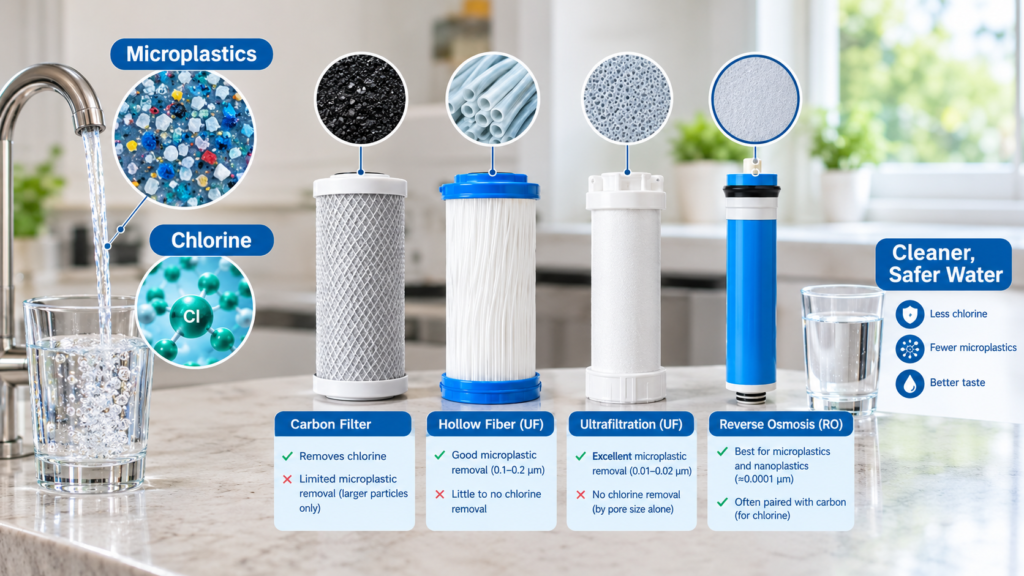
Do Water Filters Remove Microplastics and Chlorine in Tap Water? You read a headline about plastic in tap water, looked at the pitcher on your counter, and realized you have no idea what it actually catches. Filters handle chlorine and microplastics in very different ways, and the chart below shows which type does what.
Table of Contents
Quick Answer:Carbon-based filters remove chlorine, but microplastic removal depends on pore size. A 1-micron carbon block captures many larger particles but misses anything smaller, while ultrafiltration (0.01–0.02 microns) blocks most microplastics, and reverse osmosis (about 0.0001 microns) provides the most thorough filtration. Pair carbon with a fine membrane for both.
What You Need to Know
- Chlorine: Activated carbon filters remove it. Fine membranes do not remove it by pore size alone.
- Microplastics: Removal depends on pore size, from 1 micron (carbon block) down to about 0.0001 microns (reverse osmosis).
- Nanoplastics: Particles under 1 micron slip past most home filters. Reverse osmosis is the most thorough option.
- Boiling: In a 2024 lab study, boiling hard water and straining it removed up to 90% of nano- and microplastics. Soft water removed far less.
- Health: Scientists are still studying how microplastics in drinking water may affect human health. Using suitable water treatment methods may help reduce exposure, although the overall health risks are not yet fully understood.
Why Do Filters Treat Chlorine and Microplastics Differently?
Chlorine is a dissolved substance, whereas microplastics are solid particles. Carbon removes chlorine chemically, while microplastics are stopped only by pore size.
Activated carbon is a porous material used to adsorb chlorine, organic compounds, and many taste and odor-causing agents.. Nanoplastics are the subset smaller than 1 micrometer (1 µm).
That split is why a filter can be excellent at one job and silent on the other.
Filter-by-Filter Chart: Microplastics vs Chlorine
This chart sets every common filter type against both contaminants. No single technology covers every column, which is why layered setups exist.
| Filter type | Chlorine | Chloramine | Microplastics (over 1 µm) | Nanoplastics (under 1 µm) | Watch-out |
|---|---|---|---|---|---|
| Pitcher, faucet-mount or fridge (usually carbon-based) | Usually yes | Check label | Check label | Unlikely | No independent microplastic data reviewed. Trust only a printed rating |
| Carbon block, 1 µm | Yes | Yes | Many larger particles | No | Passes anything under 1 µm |
| Hollow fibre, 0.1–0.2 µm | No* | No* | Yes, above pore size | Partly | Smallest nanoplastics can pass |
| Ultrafiltration, 0.01–0.02 µm | No* | No* | Most | Partly | Particles below 0.01 µm can pass |
| Reverse osmosis, about 0.0001 µm | Usually paired with carbon* | Usually paired with carbon* | Yes | Yes | Removes minerals and sends some water to drain |
| Boiling + straining | Not reliable* | Not reliable* | Up to 90% in hard water | Up to 90% in hard water | Soft water removes far less |
Save or screenshot this filter chart — it covers which filter handles chlorine, microplastics and nanoplastics.
Pore sizes come from the water-treatment supplier Clean Water Store (carbon, ultrafiltration, reverse osmosis) and the filter maker Bachgold (hollow fibre). Boiling figures come from the 2024 study covered below. Starred cells reflect general water-treatment knowledge: confirm them against your filter’s manufacturer specifications.
Do Water Filters Remove Chlorine from Tap Water?
Yes, filters that use activated carbon do. A finer membrane is not a better chlorine filter, because chlorine is dissolved and passes straight through pores that stop particles.
That is the counterintuitive part: ultrafiltration stops far more microplastics than a carbon block, yet on pore size alone it does nothing for chlorine.
Chlorine vs chloramine
Chloramine is a disinfectant made from chlorine and ammonia, used by some utilities because it lasts longer in pipes. Carbon filters can reduce both, but chloramine is the tougher one. Filters aimed at it typically use catalytic carbon or longer contact time.
What NSF/ANSI 42 means
NSF/ANSI 42 is a standard covering aesthetic effects, including chlorine taste and odour, used to certify that a filter reduces them. If the packaging mentions neither 42 nor chlorine reduction, treat chlorine performance as unproven. [EXTERNAL LINK NEEDED: NSF/ANSI standards page, open in new tab]
Do Water Filters Remove Microplastics from Tap Water?
Some do. Pore size is the whole story: a filter can only stop particles larger than its openings.
Most microplastics detected in drinking water measure 1 to 100 µm, according to Clean Water Store. Nanoplastics fall below 1 µm.
The pore-size ladder
- 1 µm carbon block: catches many larger microplastics and passes everything smaller.
- 0.1–0.2 µm hollow fibre: traps particles larger than its pores by size exclusion.
- 0.01–0.02 µm ultrafiltration: pores 50 to 100 times finer than a 1 µm filter, blocking the vast majority of microplastics.
- About 0.0001 µm reverse osmosis: rejects microplastics, nanoplastics and most dissolved contaminants.
The nanoplastics gap
Nanoplastics can be smaller than the pores in a hollow fibre membrane. According to Clean Water Store, particles below 0.01 µm can even pass ultrafiltration. Reverse osmosis is the only home option on this list that reaches that scale.
Can You Remove Microplastics Without a Filter?
Sometimes. Boiling hard tap water and straining it removed up to 90% of nano- and microplastics in a 2024 lab study.
Researchers at Guangzhou Medical University, led by Zimin Yu, published the work in Environmental Science & Technology Letters. As hard water heats, limescale (calcium carbonate) forms and traps plastic fragments in a crust. The chalky buildup people scrub out of kettles is what does the work.
| Water hardness (mg/L calcium carbonate) | Nanoplastics removed |
|---|---|
| 80 | 34% |
| 180 | 84% |
| 300 | 90% |
. Tests used lab water spiked with plastic. Soft water removed roughly a quarter.
- Find your hardness. Check your utility’s water report or use a test strip. The study saw 84% removal at 180 mg/L and only 34% at 80 mg/L.
- Boil a full batch. Bring it to a rolling boil, the standard the World Health Organization uses for disinfection, then let it cool.
- Strain it. Pour through a stainless-steel mesh strainer, the kind used for tea, so the limescale crust stays behind.
Boiling is a disinfection method. It does not remove heavy metals or most chemicals, so it complements a filter rather than replacing one.
How Can You Check Your Own Filter in 60 Seconds?
Read three things: the micron rating, the chlorine claim, and your water’s disinfectant. A label with no micron rating and no microplastic claim should be treated as unproven for microplastics.
- Find the model or cartridge name. Look on the cartridge, the housing or the box.
- Look for a micron rating. 1 µm means partial removal, 0.1–0.2 µm is hollow fibre, 0.01–0.02 µm is ultrafiltration, and no number means unproven.
- Look for a chlorine claim. The phrase to find is NSF/ANSI 42 chlorine taste and odour reduction.
- Identify your disinfectant. Your utility’s annual water-quality report names chlorine or chloramine. In the U.S. it is called the Consumer Confidence Report.
- Match the result to the chart above. Chlorine only: carbon is enough. Microplastics: ultrafiltration or reverse osmosis
Want this as a one-page printable?
What Are the Downsides of Using a Water Filter?
The main downsides are upkeep, coverage gaps and cost. A filter only protects you while it is inside its service life.
- Upkeep: Trapped particles build up on the filter media and slow the flow. What happens if you don’t change your water filter covers the consequences.
- Coverage gaps: A filter rated for chlorine may say nothing about microplastics, and the reverse is also true.
- Reverse osmosis trade-offs: It removes minerals along with contaminants and sends part of the incoming water to drain. If you are weighing mineral-adding filters afterward, the alkaline water filter pros and cons article covers that trade-off.
- Cost: Layered setups cost more than a pitcher.
If your label check shows your filter does not reach nanoplastics, reverse osmosis is the route. The guide on how to reduce TDS in drinking water explains what reverse osmosis changes in the water that reaches your glass.
What Are the Most Common Filter Mistakes?
Filter marketing is vague, so these mistakes are easy to make. The costliest one is assuming that “filtered” means “microplastic-free.”
- Trusting the word “filtered.” Without a micron rating or a microplastic claim, there is nothing to rely on.
- Buying a finer membrane to fix chlorine taste. Carbon fixes chlorine. Membranes fix particles.
- Treating chloramine like chlorine. Check your utility’s report first.
- Boiling soft water and expecting 90%. The study’s best results came from hard water.
- Skipping replacements. Clogged media slows flow and protects less.
What Is the Best Way to Drink Water to Avoid Microplastics?
Filter your drinking water through a fine membrane and cut plastic contact elsewhere. Layering beats relying on any single filter.
Clean Water Store describes a layered home setup: a 1 µm carbon pre-filter, then ultrafiltration for the whole house, then under-sink reverse osmosis at the kitchen tap. A simpler version is a carbon pre-filter ahead of one fine membrane at the tap you drink from.
Bottled water is not a safe default. Columbia University’s Mailman School of Public Health reported in January 2024 that bottled water can contain hundreds of thousands of nanoplastics. Reusable bottles and avoiding heating food in plastic containers cut exposure further.
Are Microplastics in Tap Water Harmful?
The evidence is still early. According to the World Health Organization’s 2019 report on microplastics in drinking water, there was no clear evidence of harm at current levels, alongside large data gaps.
Microplastics have been detected in human tissue since then, but detection is not proof of harm. Reasonable caution, not alarm, is the honest reading.
When Should You Test Your Water or Call a Professional?
Test first if your situation carries extra risk. For health-related contaminants, test your water and choose a certified filter rather than guessing.
- You use a private well. No utility is treating or testing it for you.
- Your utility has issued a boil-water advisory.
- Someone in your home has a weakened immune system.
- You suspect lead or heavy metals, which need a filter certified under NSF/ANSI 53.
- Your tap suddenly smells strongly of chlorine. Call your utility.
The CDC’s page on home water treatment systems explains how to match a system to a contaminant.
FAQs
Can a Home Water Filter Reduce Microplastics in Drinking Water?
Some do, and how much depends on pore size. A 1-micron carbon block catches many larger microplastics but passes anything smaller. Hollow fibre (0.1–0.2 microns) and ultrafiltration (0.01–0.02 microns) catch far more, and reverse osmosis (about 0.0001 microns) is the most thorough. Without a stated micron rating or microplastic claim on the label, assume partial removal at best.
How Can You Remove Microplastics From Tap Water?
Choose a water filtration system that uses ultrafiltration or reverse osmosis membranes. A carbon filter installed before the membrane can help reduce chlorine, odors, and certain other contaminants.. Without equipment, boiling hard tap water and straining it through stainless-steel mesh removed Soft water removed far less, roughly a quarter.
What are the downsides of using a water filter?
The main downsides are upkeep, coverage gaps and cost. Filters that are not replaced lose flow and performance as trapped particles build up. A filter rated for chlorine may say nothing about microplastics. Reverse osmosis removes dissolved minerals along with contaminants and sends some water to drain, and layered systems cost more than a pitcher.
What is the best way to drink water to avoid microplastics?
Combine three habits. Filter drinking water through a fine membrane such as ultrafiltration or reverse osmosis. Boil and strain hard tap water if you have no such filter. Cut plastic contact with reusable bottles and by not heating food in plastic. Bottled water is not a safe default, since Columbia University researchers reported hundreds of thousands of nanoplastics in some bottles.
How Can You Lower Chlorine Levels in Tap Water With a Filter?
Yes, activated carbon filters remove chlorine, which is why pitcher, under-sink and whole-house carbon filters improve taste and smell. Membranes such as ultrafiltration do not remove dissolved chlorine by pore size alone. If your utility uses chloramine instead of chlorine, look for a filter specified for it, and check the label for NSF/ANSI 42 chlorine reduction.
Do microplastics build up in a water filter?
Trapped particles accumulate on the filter media and gradually reduce flow, which is why manufacturers set replacement schedules. A clogged filter protects less and frustrates more. Follow the replacement interval for your model, and read what happens if you don’t change your water filter for the consequences of skipping it.
Is boiling enough to remove microplastics?
Only in hard water, and only partly. A 2024 lab study found boiling plus straining removed 84% of nanoplastics at 180 mg/L hardness and 90% at 300 mg/L, but just 34% at 80 mg/L. Boiling also does not remove heavy metals or most chemicals, so treat it as a backup to filtration, not a replacement.
What to Do Next
- Replace on schedule. Read what happens if you don’t change your water filter to see what a neglected cartridge costs you.
- Considering reverse osmosis? How to reduce TDS in drinking water shows what changes in your glass.