
Introduction
How to Reduce TDS in Drinking Water Without RO Your TDS meter shows a number that looks too high, and nearly every guide you find tells you to buy a reverse osmosis system. You have other options, but only a few of them actually lower the number, and this article separates the ones that work from the ones that don’t.
Table of Contents
Quick Answer:Only distillation, deionization (DI) resin, and capacitive deionization (CDI) substantially lower TDS without reverse osmosis. Carbon filters, sediment filters, UV, softeners, and boiling do not purify water. Blending tap with low-TDS water also works: 1 gallon of 480 ppm tap plus 2 gallons of 10 ppm distilled water results in about 167 ppm.
What You Need to Know
- Most home filters don’t lower TDS. Carbon, sediment, and UV filters treat other problems.
- Three non-RO technologies do lower it: distillation, DI resin, and CDI. Blending with low-TDS water is the cheapest adjustment.
- Softeners and boiling don’t reduce TDS. Both can leave it flat or slightly higher.
- TDS is not a safety score. According to the U.S. EPA, the 500 mg/L guideline is a secondary standard based on taste and appearance, not health.
- Measure first. A high reading may not need fixing at all.
How Do You Reduce TDS Without RO?
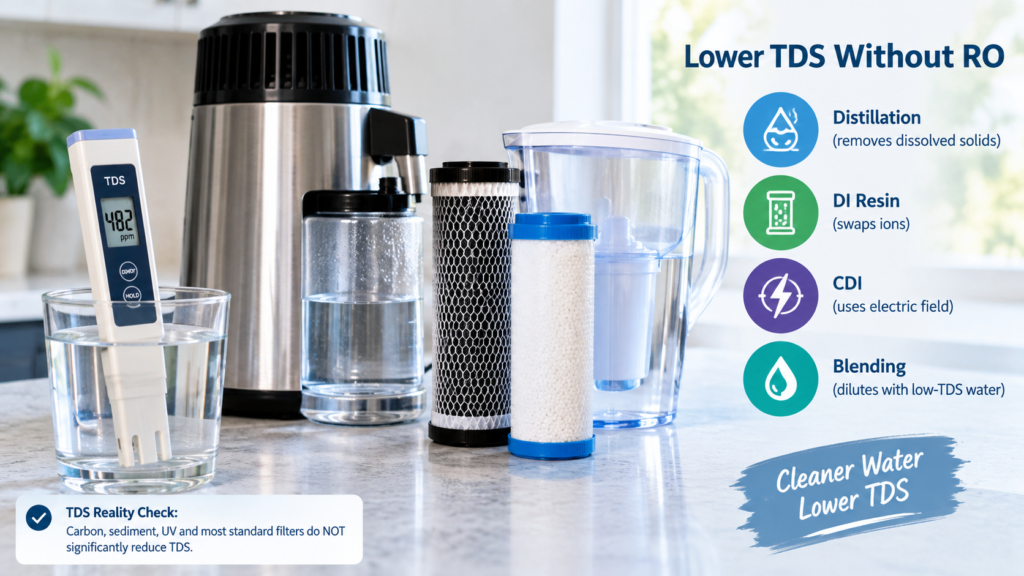
Use distillation, DI resin, CDI, or blending with low-TDS water, because these are the only non-RO approaches that actually remove or dilute dissolved solids. It’s frustrating when the standard fix needs plumbing, space, or a lot of wasted water. According to Atlas Scientific, traditional RO systems waste 2 to 4 gallons for every gallon of filtered water.
- Distillation: boils water and condenses the steam, leaving dissolved solids behind.
- DI resin: swaps dissolved ions for hydrogen and hydroxide.
- CDI: pulls ions onto electrodes with an electric field.
- Blending: dilutes your tap water with water that already has very low TDS.
Do Water Filters Reduce TDS?
No. Standard carbon, sediment, and UV filters leave dissolved solids in the water. Total dissolved solids (TDS) is the combined amount of dissolved minerals, salts, metals, and organic matter in water, usually measured in parts per million (ppm) or mg/L, used to gauge mineral content. Atlas Scientific notes that TDS covers whatever passes through a 2-micrometre filter.
| Method | Lowers TDS? | What it actually does | Easy for renters or mobile setups? |
|---|---|---|---|
| Carbon pitcher or faucet filter | No | Reduces chlorine, taste, odor | Yes |
| Under-sink carbon block | No | Same, at higher volume | Moderate |
| Sediment filter | No | Catches particles | Moderate |
| UV light | No | Disinfects microbes | Moderate |
| Water softener | Not really; can rise slightly | Swaps calcium and magnesium for sodium or potassium | No (plumbed) |
| Boiling | No; rises slightly | Kills microbes, evaporates some water | Yes |
| Mineral or alkaline cartridge | No; can raise it | Adds minerals by design | Yes |
| Distillation | Yes, large | Vaporizes and condenses water | Yes (countertop units) |
| DI resin | Yes, large | Ion exchange | Yes (cartridges), but resin depletes |
| CDI | Yes (best at lower starting TDS) | Electrodes capture ions | Limited |
| Blending with low-TDS water | Yes, proportional | Dilutes | Yes |
Save or screenshot this TDS Reality Chart. It shows at a glance which filter types can and can’t lower a TDS reading.
Check a filter’s performance data sheet before buying.
What TDS Level Is Too High?
There’s no health-based limitAccording to the EPA’s secondary drinking water guidelines, TDS levels above 500 mg/L may affect the taste and visual quality of drinking water.. Atlas Scientific also describes the 500 ppm as an aesthetic figure. You can read the details on the EPA’s drinking water regulations page (opens in new tab).
A TDS meter estimates TDS from electrical conductivity. Atlas Scientific notes that conductivity is directly proportional to TDS. Because meters convert with a fixed factor, treat the reading as an estimate.
How to Measure Your TDS at Home
- Rinse the probe. For accurate readings, calibrate your TDS meter according to the manufacturer’s instructions and use the recommended calibration solution.
- Collect a sample. Run the cold tap for about 30 seconds, then fill a clean glass.
- Submerge to the marked line. Stir gently to clear bubbles from the probe.
- Wait for the reading to settle. Record the final number, not the first flicker.
- Test the filtered output too. Compare it to the tap reading to see whether your filter changes anything.
- Before paying for a water treatment solution, verify the TDS reading with another meter or have your water tested by a qualified laboratory.
[CONTENT GAP: TDS vs. water hardness explainer]
[CONTENT GAP: best TDS meters guide]
Method 1: Does Distillation Lower TDS?
Yes. Distillation lowers TDS dramatically because dissolved solids stay behind when water turns to steam. According to Atlas Scientific, the process can eliminate up to 99.9% of TDS.
The tradeoffs are real. Distillation is slow, uses a lot of heat energy, and strips out all minerals. Atlas Scientific also notes that some volatile organic compounds can travel with the steam.
For most renters or mobile households, a countertop distiller is the simplest non-RO option.
Method 2: What About DI Resin and CDI?
DI resin and CDI both lower TDS, but each fits a narrower use than distillation.
Deionization (DI) Resin
Deionization is a process that uses cation and anion exchange resins to replace dissolved ions with hydrogen and hydroxide ions, which combine into pure water. Atlas Scientific says it often reaches below 10 ppm. The catch: high-TDS water uses up the resin quickly, and resin must be regenerated or replaced. Atlas Scientific lists labs, electronics manufacturing, and aquariums as typical uses
Capacitive Deionization (CDI)
Capacitive deionization is an emerging method that applies an electric field across electrodes to capture charged ions. According to Atlas Scientific, it uses less energy than RO or distillation, but it costs more upfront and works best when starting TDS is already lower. It also needs electronic controls, so it’s not a casual household purchase yet.
Do Water Softeners and Boiling Reduce TDS?
No. Softeners swap ions rather than remove them, and boiling concentrates what’s left. Atlas Scientific lists “only lowers TDS concentration” selectively as a softener limitation, because the system exchanges ions instead of eliminating them.
Here’s the counterintuitive part. By simple atomic-mass arithmetic, the dissolved solids by weight stay flat or rise slightly. A conductivity meter may read it a bit differently.
Boiling also keeps minerals in the pot. As water evaporates, the minerals that remain become more concentrated. Boiling kills microbes, but it won’t lower your meter reading.
Worked Example: Blending Tap Water to a Target TDS
Blending lowers TDS by mixing high-TDS tap water with low-TDS water in a known ratio. The figures provided below are examples for demonstration purposes only. Refer to your own test results for accurate information.Conductivity-based readings of mixtures are approximate.
The formula is: final TDS = (V1 × C1 + V2 × C2) ÷ (V1 + V2).
- Measure both sources. Assume tap water is 480 ppm and your distilled water is 10 ppm.
- Pick a target. Assume you want 200 ppm.
- Find the tap fraction. (200 − 10) ÷ (480 − 10) ≈ 0.40, so about 40% tap and 60% distilled.
- Convert to quarts per gallon. About 1.6 quarts of tap plus 2.4 quarts of distilled.
- Verify with your meter. Adjust in small steps until the reading matches.
Which Non-RO Method Is Right for You?
Choose a treatment method based on your needs: blending may moderately lower TDS, while distillation or deionization can reduce it further. Before treating your water, check its overall quality and whether treatment is necessary.
- If your TDS reading is below 500 ppm and the water has an acceptable taste, further treatment may not be necessary.. The EPA figure is aesthetic.
- If hard-water scale is your main concern, a water softener can help protect appliances, although it generally does not reduce the total dissolved solids (TDS) level.
- If you want large TDS reduction and can’t install RO, use a countertop distiller.
- For applications that require very low TDS levels, such as certain laboratory tasks or aquariums, consider using a deionization (DI) resin system.
- To lower TDS moderately, mix tap water with distilled water according to the calculation provided earlier.
- If you suspect a specific contaminant, get a lab test first, because TDS can’t identify it.
Want this chart and decision tree as a one-page printable? Join the Filter Expert Hub newsletter and we’ll send the TDS cheat sheet. [EMAIL CAPTURE POINT: insert signup form or link]
Is Low-TDS Water Better for You?
Not by itself. TDS measures how much is dissolved, not whether it’s harmful, and the EPA guideline is aesthetic. Atlas Scientific notes that RO removes beneficial minerals responsible for taste, and distillation also removes all minerals. Many people find very low-TDS water tastes flat.
If you want some minerals back in your water, mineral cartridges are the usual route, and they raise the TDS reading by design. Our guide to thee pros and cons of alkaline water filters covers that tradeoff in detail.
When Is TDS Not the Real Problem?
When you’re worried about safety, TDS can’t tell you what’s in the waterTDS measurements cannot confirm whether contaminants such as lead, nitrate, arsenic, or bacteria are present in water, regardless of whether the reading is low or high.. If you’re on a private well or suspect a specific contaminant, get a lab test and talk to a water-treatment professional before choosing equipment.
What Are the Most Common TDS Mistakes?
The biggest mistake is assuming any filter lowers TDS. These are the common ones:
- Trusting a carbon pitcher to drop the number. It treats chlorine and taste, not dissolved minerals.
- Reading a meter with an unrinsed probe or a poor sample. That produces unreliable numbers.
- Treating a lower TDS as “safer.” The reading says nothing about health.
- Buying DI resin for high-TDS tap water. The resin depletes fast, and the cost adds up.
- Boiling water to “purify” it for TDS. Boiling disinfects but concentrates minerals.
FAQs
How to lower TDS without RO?
Use distillation, DI resin, or CDI for large reductions, or blend tap water with low-TDS water for a moderate drop. Softeners, boiling, carbon, sediment, and UV filters won’t meaningfully reduce TDS. Measure your starting number first so you know how much reduction you actually need.
How can I reduce TDS in my water using a water filter?
Standard carbon, sediment, and UV filters generally don’t lower TDS because dissolved minerals pass through them. Check the filter’s performance data sheet for an explicit TDS reduction claim. If there isn’t one, pair your filter with distillation, DI resin, or blending to actually lower the number.
How to bring TDS down?
Measure your current TDS, then pick a method that matches your goal. Distillation and DI resin cut TDS sharply, while blending with distilled water lowers it in proportion to the ratio you mix
How to purify water without RO?
Purification and TDS reduction are different goals. Boiling and UV treatment disinfect water but don’t lower TDS. Distillation does both: it removes dissolved solids and leaves most microbes behind, though some volatile compounds can carry over.
Do water softeners reduce TDS?
Not meaningfully. A softener exchanges calcium and magnesium for sodium or potassium rather than removing dissolved solids. By atomic mass, the total can stay flat or rise slightly. Softeners are still useful for preventing scale on pipes and appliances, but they aren’t a TDS-reduction tool.
Is distilled water safe to drink?
Distilled water is usually suitable for drinking, but removing most minerals can give it a flat taste. If you have a medical condition or concerns about your mineral intake, consult a healthcare professional for advice.
What to Do Next
Now that you know which methods change TDS, your next question is probably which filter you should actually keep on your tap. Start with the pros and cons of alkaline water filters to see how mineral-adding cartridges affect your water.
If you use carbon cartridges, how often to replace a water filter covers the replacement schedule. For choosing between setups, see RV water filters vs. house filters.
[CONTENT GAP: best water filters reviews roundup]
[CONTENT GAP: is distilled water safe to drink, full guide]