
Introduction
What Happens If You Don’t Change Your Water Filter on Time? Your filter’s indicator light has been red for weeks, or you just can’t remember the last time you swapped the cartridge. You’re probably fine, and here’s precisely what an overdue filter does, who should worry, and what to do today
Table of Contents
Quick AnswerAn overdue water filter clogs, slows your flow, and stops removing contaminants as designed. Most healthy people face a low health risk, but filters meant to remove lead need changing on schedule. A standard Brita pitcher filter is rated for 40 gallons, about 2 months of typical use.
What You Need to Know
- An overdue filter loses capacity. Flow slows, taste worsens, and contaminants it once caught can pass through.
- Filters have two limits: gallons and months. Whichever you hit first is your real deadline.
- Most carbon filters are not built to kill bacteria, so a wet, old cartridge can become a place microbes settle.
- Risk is highest for lead-removal filters and for infants, pregnant people, and anyone with a weakened immune system.
- Fix it in under 10 minutes: replace the cartridge, flush it, reset the indicator, and set a reminder.
What Happens If You Don’t Change Your Water Filter?
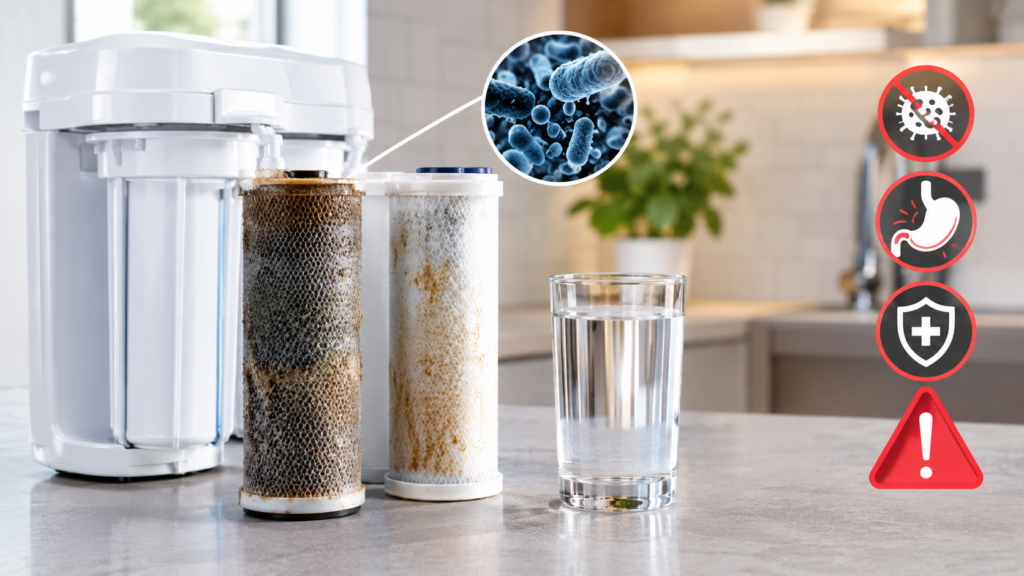
An overdue filter works worse and then eventually stops working as designed. The effects arrive in a
- Flow slows. Trapped sediment and scale restrict the cartridge.
- Taste and smell change. The carbon that absorbs chlorine and odors is used up.
- Removal drops. Contaminants the filter was rated to catch can pass through.
- Microbes can settle. A wet, saturated cartridge is a place bacteria can colonize.
- Equipment strain follows. Clogging can stress pumps, valves, and ice and water lines in the appliance.
An overdue filter is not the same as no filter. You usually receive partial protection, but you lose the guarantee. The manufacturer’s rating only holds up to the stated limit.
Can Not Changing a Water Filter Make You Sick?
While it is possible, the risk is low for most healthy people who consume treated municipal water. The risk depends on what your filter is for and who is drinking the water.
Can bacteria really grow in an old filter?
A water filter is a device that removes particles and chemicals from water, and most carbon pitcher and fridge filters are not designed to disinfect it. The cartridge stays wet and holds organic material, which gives microbes a surface to colonize. The research here is about colonization and taste problems, not widespread illness in healthy households. If you see slime, mold, or algae, replace the filter immediately.
What happens to lead and PFAS filters when they’re overdue?
The EPA says a lead-certified filter only protects you if you replace the cartridge on time. Its guidance stresses following the manufacturer’s instructions and changing the cartridge on schedule.. That’s the counterintuitive part: heating overdue water doesn’t make it safe from lead. Look for filters certified to NSF/ANSI Standard 53, the standard for health-effect claims like lead reduction.. epaepa
Who should be most careful?
Infants, pregnant people, and anyone with a weakened immune system should not push filter limits. Households on private well water should be stricter, because the source water isn’t pre-treated. Free of a diagnosis, the rule is simple: if the filter protects someone vulnerable, change it early.
[EXTERNAL LINK: CDC home water filter guidance—DATA MISSING: confirm exact URL before publishing; opens in new tab]
How Long Can You Go Without Changing Your Water Filter?
You can’t safely rely on a filter past its rated limit, and the limit is whichever comes first: gallons or months. Manufacturers don’t publish a grace period.
| Filter | Capacity limit | Time limit |
|---|---|---|
| Brita Original (white) | 40 gallons | About 2 months |
| Brita Stream (gray) | 40 gallons | About 2 months |
| Brita Elite (blue) | 120 gallons | About 6 months |
| Brita faucet system (SAFF-100, FF-100) | 100 gallons | About 4 months |
| Fridge, under-sink, RO, whole-house, RV | Set by the maker | Check your manual |
Brita lists these intervals on its own support page and says hard water may require more frequent changes. [DATA MISSING: manufacturer limits for your fridge, under-sink, and RO models—add from the manual]] brita
Overdue Filter Risk Chart by Filter Type
Each filter type fails differently, so the same “overdue” means different things. Use this chart to see what to expect and what to do.
| Filter type | What fails first | Realistic risk | What to do |
|---|---|---|---|
| Pitcher | Taste, then removal capacity | Low for most; higher if used for lead | Replace now, reset the indicator |
| Fridge | Flow, then ice and water line buildup | Low to moderate | Replace per model; run the dispenser to flush |
| Under-sink / faucet | Flow, then breakthrough | Moderate if lead-certified | Replace, flush cold water per manual |
| Reverse osmosis | Prefilters clog, then membrane stress | Moderate; protects the membrane | Replace prefilters first; check membrane schedule |
| Whole-house | Pressure drop, sediment bypass | Low health, high equipment strain | Replace; shorter cycles on well water |
| RV | Stagnant water, flow loss | Moderate; water sits idle between trips | Replace; see the RV schedule below |
Save or screenshot this Overdue Filter Risk Chart. It covers every filter type in one place.
Worked example: when is your pitcher really due?
Say a household of four runs about 1.5 gallons a day through a 40-gallon Brita Original filter. That’s 40 ÷ 1.5 ≈ 27 days, not two months.. Replace it with your own.) If you use the filter for drinking, coffee, and cooking, you can hit the gallon limit first.
What about an RV filter?
RV filters sit in stagnant hoses and tanks between trips, so time and volume both matter. Read how often to replace an RV water filter for the schedule, and see why full-time RVers need a water filter if you’re on the road year-round.
How Do You Know Your Filter Is Overdue?
Slow flow, odd taste or smell, a lit indicator, or visible slime are the clearest signs. Check these in order:
- Look at the indicator. Many pitchers and fridges show green, yellow, or red. EPA’s filter guidance reads red as “change now” and yellow as “change soon.” EPA
- Count the gallons or months since your last change.
- Taste and smell a glass. Chlorine or earthy flavors mean the carbon is spent.
- Time the fill. If it takes noticeably longer than when the filter was new, it’s clogged.
- Inspect it. Mold, algae, slime, or a cracked housing means replace immediately.
Any single sign is enough to act. You don’t need all five.
Do Water Filters Go Bad If Not Used?
An unopened, sealed filter doesn’t expire, but a wet one starts its clock. Brita says the shelf life of an unused filter is indefinite as long as the pouch is sealed. Once you install and wet a cartridge, it can sit and collect microbes even if you barely use it. That’s why time limits exist alongside gallon limits. brita
What to Do Right Now If Your Filter Is Overdue
Replace the cartridge and flush it, which takes about 10 minutes. Don’t panic-buy a new system. You’re fixing a maintenance gap.
- Check your model and limit. Find the capacity and time limit in the manual or on the maker’s site.
- Buy the matching cartridge. For lead protection, confirm it lists NSF/ANSI Standard 53.
- . Wash the pitcher or housing with mild soap if you see residue.
- Install the new cartridge and make sure it’s seated tightly. A loose seal lets unfiltered water bypass it.
- Flush it per the manual. For many faucet and pitcher filters, that means running cold water only. Never run hot water through it.
- Reset the indicator, then set a phone reminder for the next change date.
Need a hand with an RV system? Follow how to install an RV water filter for the full walkthrough.
Want the reminder done for you? Grab our free printable filter-change tracker and never guess a date again. [EMAIL CAPTURE: insert form/CTA]
Common Mistakes With Overdue Filters
The biggest mistake is trusting the calendar and ignoring the gallons.
- Using a filter past capacity because only two months have passed.
- Boiling water to fix it. Boiling doesn’t remove lead.
- Running hot water through the filter, which can damage the media.
- Forgetting to reset the indicator, so the next alert is wrong.
- Buying a non-certified replacement for a lead-removal filter.
- Skipping the flush after installing a new cartridge:
When to Call a Professional or Test Your Water
Test your water if you’re on a private well, under a boil-water notice, or having repeated stomach illnesses you can’t explain. A filter swap won’t fix a contaminated source. Contact your water utility for a report, or use a state-certified lab for well water. If someone vulnerable is affected, talk to a doctor.
FAQ
How long can you go without changing your water filter?
Not past the manufacturer’s rated limit. That limit is a gallon amount and a time period, and you should change the filter at whichever arrives first. For a standard Brita filter, that’s 40 gallons or about two months. Manufacturers don’t publish a grace period, so overdue means you can no longer count on the rated performance.
Can you get sick from not changing a Brita filter?
It’s possible but uncommon for healthy people on treated tap water. A saturated, wet cartridge can lose removal capacity and may harbor microbes. The bigger concern is lead, if you rely on the filter for that. If you see mold, slime, or algae, replace it immediately and wash the pitcher with mild soap.
Can not changing the water filter make you sick?
Yes, in some situations. An overdue filter can let contaminants through and may host bacteria on a wet cartridge. For most healthy adults the risk is low. Risk rises for infants, pregnant people, people with weakened immune systems, private-well users, and anyone depending on a filter certified for lead.
Can a Water Filter Expire While in Storage?
A sealed, unopened filter doesn’t expire, according to Brita. Once installed and wet, a cartridge can collect microbes even with light use, which is why filters also carry a time limit. If you’ve been away for weeks, flush the filter per the manual and replace it if it’s past its time limit.
Can an overdue filter damage my fridge or water system?
It can. A clogged filter restricts flow, which can strain pumps, valves, and ice-maker lines, and sediment or scale can build up downstream. Slow dispensing is the first sign. Replacing the cartridge on schedule is cheaper than repairing the system, so check your manual for the exact interval.
How can I tell if my water is safe after an overdue filter?
You can’t confirm safety by taste alone. Replace the filter, flush it as directed, and watch for odd smells, colors, or slow flow. If someone vulnerable drinks the water or you’re on well water, test it. Call your utility if there’s a boil-water notice, since a filter swap won’t fix that.
What to Do Next
- Set your schedule with how often to replace an RV water filter.
- Choose the right setup with RV water filter vs. house filter.
- Learn why full-time RVers need a water filter.