
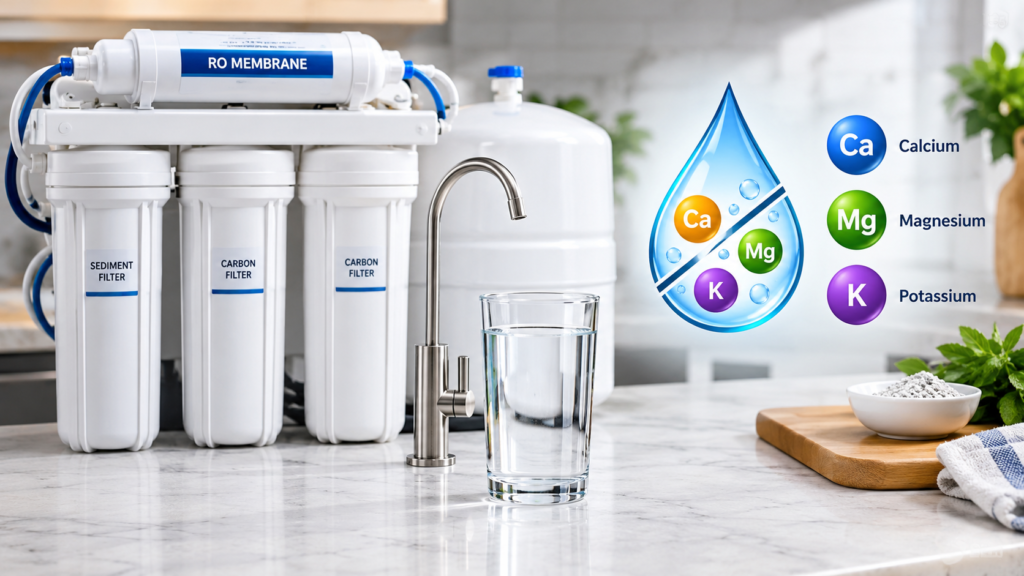
Introduction
Does Reverse Osmosis Remove Essential Minerals From Water? You just read that reverse osmosis strips the minerals out of your water, and now your new filter feels like a mistake. It isn’t one. The claim is partly true, and this article shows you how much you actually lose and how to put minerals back if you’d like to.
Table of Contents
Quick Answer:Yes. Reverse osmosis removes most dissolved minerals, including calcium, magnesium, and potassium, typically about 90–99% depending on the membrane. Drinking water usually supplies only a small share of your daily minerals, so a balanced diet covers most people. If you want minerals back, add a remineralization stage or mineral drops.
What You Need to Know
- Reverse osmosis filters reduce the amount of dissolved minerals in water by preventing many dissolved substances from passing through the membrane, including both useful minerals and unwanted contaminants
- In the worked example below, 2 liters of tap water supplies under 10% of an adult’s daily calcium and magnesium target. Your numbers depend on how hard your tap water is.
- German risk assessors (BfR) found no long-term health effects from very low-mineral water for people with a balanced diet and normal drinking amounts.
- Infant formula, kidney conditions, and mineral-restricted diets are the cases where you should ask a professional first.
- Adding minerals back is optional for most adults, and it takes one cartridge, drops, or a diet tweak
Does Reverse Osmosis Remove Essential Minerals?
“Yes. Reverse osmosis (RO) is a filtration method that pushes water through a semi-permeable membrane to reject dissolved solids, including calcium, magnesium, sodium, and potassium. Household RO membranes typically reject roughly 90–99% of dissolved minerals.
The membrane can’t tell a helpful mineral from a harmful contaminant. It blocks dissolved ions by size and charge, so the same membrane that holds back lead and nitrate also holds back calcium.
That’s why TDS drops sharply after RO. Total dissolved solids (TDS) is a measure of everything dissolved in water, reported in milligrammes per litre (mg/L). The exact rejection rate varies by membrane and system, so check your spec sheet and look for NSF/ANSI 58 certification, the standard for RO systems.
How Much Do You Actually Lose? The Mineral Math
Probably less than you fear. For most adults, the minerals removed from a couple of liters of tap water are a small slice of daily needs. Your share depends on how hard your tap water is.
The formula is simple: mg/L × liters per day = mg per day. For RO water, multiply the tap result by the share the membrane lets through (1 minus the rejection rate).
Illustrative example. The tap values and the 95% rejection rate below are assumptions, so replace them with your own.
| Mineral | Adult daily target (NIH ODS) | Assumed tap water | 2 L of tap | 2 L of RO (95% rejection) | Gap vs. target |
|---|---|---|---|---|---|
| Calcium | 1,000 mg (ages 19–50) | 40 mg/L | 80 mg | 4 mg | 76 mg, about 7.6% |
| Magnesium | 310–420 mg, by age and sex | 15 mg/L | 30 mg | 1.5 mg | 28.5 mg, about 7–9% |
| Your water | Look up on NIH ODS | ___ mg/L | ___ | ___ | ___ |
Save or screenshot this Mineral Math table. It covers checking your own calcium and magnesium gap in about five minutes. The targets come from the National Institutes of Health Office of Dietary Supplements fact sheets on calcium and magnesium.
Run your own numbers in five steps
- Check whether the report lists hardness instead. Hardness is expressed as calcium carbonate, not as separate minerals. Ask your utility for calcium and magnesium separately.
- Multiply each value by the liters you drink daily. Count tea, coffee, and cooking water too, not just glasses.
- Compare the result to the NIH target above. The difference between the tap and RO columns is what you’d need to replace.
- Measure your RO output with a handheld TDS meter. Compare it with a tap reading. A rising RO reading over months usually signals a tiring membrane, not “more minerals.”
Why Does RO Remove Minerals, and Why Does pH Drop?
RO removes minerals because its membrane blocks dissolved ions, and pH often drops because water with few minerals resists change poorly
Calcium and magnesium bicarbonates normally help hold water’s pH steady. Take them out, and the water picks up dissolved CO₂, which forms a weak acid.
A glass of mildly acidic water doesn’t change your blood pH, which your body regulates tightly. The practical effect is a flat taste, which you can fix by adding minerals back.
Is Drinking RO Water Bad for You?
The evidence on long-term, exclusive use of very low-mineral water is mixed, and agencies have said so openly. Germany’s Federal Institute for Risk Assessment (BfR) concluded in 2020 that very low-mineral water causes no long-term adverse effects with a balanced diet and normal drinking amounts.
What the WHO reviewed
The World Health Organization convened experts in 2003 to examine the long-term health effects of demineralized water and how best to reconstitute it. The result was the publication Nutrients in Drinking-water (2005).
BfR’s opinion refers back to that WHO publication and to Kozisek’s chapter in it on demineralized water. The concern in that literature is lower mineral intake in people whose diets are already marginal, not poisoning.
The real downsides
- Intake gap: if your diet is thin in calcium or magnesium and your tap water is hard, RO removes a more meaningful share of your intake.
- Cooking: The WHO publication’s review covers research suggesting food cooked in very low-mineral water can lose some minerals to the cooking water.
- Taste: RO water often tastes flat, and people who dislike it tend to drink less.
The “RO leaches minerals from your body” claim
Evidence for this is thin. Some animal studies and observational research raise concerns about very low-mineral water, but human data on ordinary home RO use is limited. The better-supported worry is lower intake, not extraction.
One counterintuitive point: some city supplies are naturally soft and already low in calcium and magnesium, so RO may change your water less than you’d expect.
Who Should Care About Minerals in RO Water?
You should care if you drink a lot of RO water on a thin diet, prepare infant formula with it, or follow a medical mineral plan. For everyone else, mineral content is mainly a taste and preference question.
Work through this decision tree in order:
- Do you eat a varied diet with dairy, leafy greens, nuts, or legumes? If yes, no action is needed beyond taste.
- Do you mix infant formula with RO water? Ask your pediatrician first.
- Do you have kidney disease or a prescribed mineral-restricted diet? Ask your clinician before changing mineral intake in either direction.
- Does the water taste flat, or do you drink too little? Add mineral drops or a remineralization cartridge.
Which Water Filters Remove the Most Minerals?
Distillation, deionization, and reverse osmosis remove the most dissolved minerals. Carbon, sediment, and ultrafiltration filters leave most of them in the water. Water softeners swap hardness minerals rather than removing them: ion exchange trades calcium and magnesium for sodium or potassium.
| Filter type | Reduces dissolved minerals? | Notes |
|---|---|---|
| Reverse osmosis | Yes, most | Also reduces many contaminants |
| Distillation | Yes, nearly all | Slow, uses energy |
| Deionization | Yes, nearly all | Common in labs and aquariums |
| Water softener (ion exchange) | Swaps, not removes | Adds sodium or potassium |
| Activated carbon | Little | Targets chlorine, taste, odor |
| Sediment / ceramic / ultrafiltration | Little | Physical particle removal |
If microplastics are your concern, see how filter types compare in our guide on whether water filters remove microplastics.
Can You Drink Reverse Osmosis Water Without Adding Minerals?
Adding minerals back is optional for most adults, not mandatory. BfR’s 2020 conclusion supports this for balanced diets and normal drinking amounts.
Add minerals if you drink RO water as your main fluid, dislike the flat taste, or live where your diet and tap water are both low in calcium and magnesium.
How to Add Minerals Back to RO Water (4 Methods)
You can restore minerals through food, drops, a cartridge, or blending. Start with the simplest one that fits your situation. Food is the most reliable mineral source, and everything else is a supplement to it.
- Eat the minerals. Dairy, leafy greens, nuts, and legumes are sources of calcium and magnesium. The NIH calcium and NIH magnesium fact sheets list food sources and amounts.
- Add mineral drops or powder. Follow the label’s dose per litre exactly. Do not guess, because concentrations vary by product.
- Install a remineralization stage. A remineralisation or alkaline post-filter is a final cartridge after the RO membrane that adds calcium and magnesium back, and some versions raise pH. Our breakdown of alkaline water filter pros and cons shows what to expect. [AFFILIATE LINK: remineralisation cartridge]
- Blend with a small portion of mineral-rich water. Only do this if your source water has been tested and is safe, since blending reintroduces whatever the RO membrane removed.
Want the Mineral Math table as a printable one-pager with blank rows for your own water report?
Common Mistakes With RO and Minerals
The most common errors are guessing instead of measuring and fixing the wrong problem. A rising TDS reading from your RO output is usually a worn membrane, not added minerals.
- Judging by taste alone. Check your tap’s calcium and magnesium before deciding you need a fix.
- Putting a remineralizer in the wrong place. It belongs after the membrane, as the last stage.
- Overdosing mineral drops. More than the label dose doesn’t make water healthier.
- Using RO water for formula without asking. Get pediatric guidance first.
- Skipping the TDS meter. A cheap meter catches membrane wear early.
- Believing “leaching” scare claims. The evidence is limited, so base decisions on your own intake gap.
When to Talk to a Professional
or heart or bone conditions. Talk to a pediatrician before using RO water for infant formula. A water lab test is the right call if your tap source is a private well.
Frequently Asked Questions
Does reverse osmosis remove essential minerals?
Yes. RO membranes reject most dissolved ions, including calcium, magnesium, sodium, and potassium, typically around 90–99% depending on the membrane and system. That lowers TDS sharply. For most adults eating a varied diet, drinking water is a small share of daily mineral intake, so the practical impact is usually modest.
“What Are the Potential Drawbacks of Drinking RO Water?”
RO water may taste bland because it contains fewer dissolved minerals. People who get little calcium or magnesium from their diet may also need to pay attention to their mineral intake. In addition, cooking with low-mineral water may affect the mineral content of some foods.” according to the WHO publication’s literature review. Germany’s BfR found no long-term adverse effects with a balanced diet and normal drinking amounts.
Which water filter removes the most minerals?
Distillation, deionization, and reverse osmosis remove the most dissolved minerals. Carbon, sediment, ceramic, and ultrafiltration filters leave most minerals in. Water softeners don’t remove hardness minerals; they exchange calcium and magnesium for sodium or potassium. If you want minerals reduced and contaminants removed together, RO is the usual home choice.
Can you drink reverse osmosis water without adding minerals?
Yes, for most adults with a balanced diet. BfR concluded very low-mineral water has no long-term adverse effects under normal conditions. Add minerals back if you dislike the taste, drink RO water as your main fluid on a mineral-poor diet, or follow medical advice to raise mineral intake.
“Can Drinking Reverse Osmosis Water Deplete Your Body’s Minerals?”
Evidence for this claim is thin. Some animal and observational research raises questions about very low-mineral water, but human data on ordinary home RO use is limited. The better-supported concern is reduced mineral intake from water, which food and remineralization can offset. Ask a clinician if you have a mineral-sensitive condition.
Is RO water safe for baby formula?
Ask your pediatrician before using RO water for infant formula. Infants are more sensitive to mineral and electrolyte balance, and formula is designed with its own nutrient profile in mind. Do not rely on general articles for this decision, including this one.
What to Do Next
- Add minerals back: compare options in our guide to alkaline water filter pros and cons.
- Check what else your filter catches: see whether water filters remove microplastics.
- Filtering on the road or at home: if you also treat water in an RV or house, read RV water filter vs house filter.