
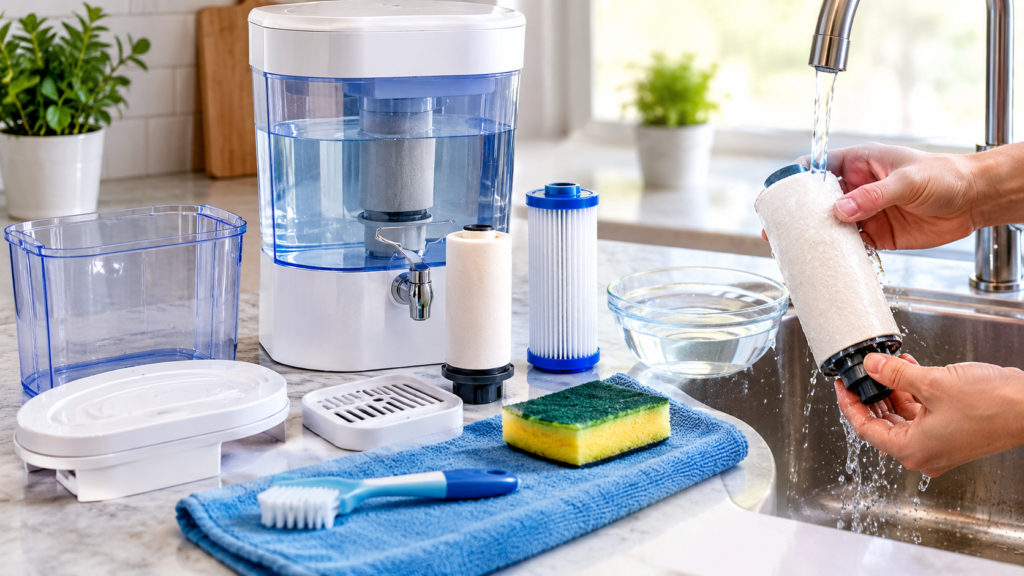
Introduction
How to Clean and Maintain a Countertop Water Filter at Home Your countertop filter is pouring slower, or the water tastes flat, and you can’t remember the last time anyone cleaned it. You can clean the housing, reservoir, and spout in one sitting, and the one part you can’t wash is easy to find.
Table of Contents
Quick Answer:To clean a countertop water filter, empty the unit, wash the housing, reservoir, and lid with mild soap and warm water, and rinse any ceramic element under cool running water for about 2 minutes. Reassemble, then flush for 5 minutes. Sealed carbon cartridges can’t be washed. Please replace them according to your manual
What You Need to Know
- Clean the housing monthly; replace cartridges on schedule. Cleaning the housing does not extend cartridge life.
- Only some filter media can be cleaned. Ceramic elements can be scrubbed, and sealed carbon cartridges are replace-only in most manuals.
- Never use soap on a ceramic element. Soap is fine on the housing, reservoir, and lid.
- Vinegar is for scale on hard parts. Check your manual before soaking any cartridge.
- Your manufacturer’s manual overrides everything here..
How Do You Clean a Countertop Water Filter?
Cleaning a countertop water filter means washing the housing and any reusable element, then flushing the unit before use. The steps below follow the guidance published by filter makers and retailers.
- Read the cleaning section of your manual first. Look for which parts are removable, which are dishwasher-safe, and whether the filter is described as “cleanable” or “replace only.” This takes two minutes and prevents the most expensive mistake.
- Empty and disassemble the unit. Unplug it if it’s electric, pour out the remaining water, and lift out the filter. Lay every part on a clean towel so nothing gets mixed up.
- Wash the housing, reservoir, lid, spout, and drip tray. . ProOne’s maintenance guidance confirms filter housings can be washed with soap and warm water. Skip bleach and strong disinfectants, which can damage plastic and filter media.
- Clean the ceramic element if your filter has one. Hold it by its base and run the ceramic part under cool water for about 2 minutes. . According to ProOne, do not use soap on the element and do not let water enter the stem.
- Descale white film with diluted vinegar. If the spout or reservoir has chalky white buildup, wipe or soak those hard parts in white vinegar diluted with water. Rinse until no smell remains.
- Rinse and let everything dry fully. Regal Flow’s guide notes that damp filters can attract bacteria. Lay ceramic elements on their side to dry.
- Reassemble and flush for 5 minutes. Regal Flow recommends running clean water through the system for 5 minutes before drinking. Discard that water.
Clean It or Replace It? The Decision Table
Most countertop filters have one cleanable part and one part you replace. Washing the wrong one wastes time or damages the filter.
| Filter part or type | Clean it? | How | Replace when |
|---|---|---|---|
| Housing, reservoir, lid, spout, tray | Yes | Mild soap, warm water, soft brush | Cracks, stains, or odor that won’t wash out |
| Gravity ceramic element | Yes | Cool water, soft scrub, no soap (ProOne guidance) | When worn down or when your manual says |
| Pleated sediment pre-filter | Rinse | Rinse out under water (ProOne guidance) | Per your manual |
| Sealed carbon cartridge (pitcher, dispenser) | No, in most manuals | Do not soak or scrub unless your manual says so | Per your manual, or when taste or flow declines |
| Countertop RO or faucet-mount filter | Follow your manual | Housing wiping and flushing only, unless stated | Per your manual |
Save or screenshot this clean-or-replace table. It covers every common countertop filter part in one glance.
Waterdrop’s maintenance guide lists activated carbon media at 6 to 18 months of service life. Ultrafiltration media runs for 1 to 2 years, and reverse osmosis media for 2 to 3 years. Your manufacturer’s number takes priority.
Want this as a one-page printable checklist for your fridge? [EMAIL CAPTURE LINK: printable countertop filter cleaning checklist] And we’ll send it with a monthly reminder.
Can You Use Vinegar to Clean a Water Filter?
White vinegar is a reasonable descaler for hard parts like the reservoir, lid, and spout, but it is not a safe default for filter cartridges. One retailer guide, Regal Flow, suggests soaking some reusable filters in equal parts vinegar and water for 30 minutes. That advice conflicts with ProOne’s rule against soaps on ceramic elements and with the sealed design of many carbon cartridges. When two sources disagree, the manual decides. If the manual doesn’t mention vinegar, use it on housings only and rinse until the smell is gone.
How Often Should You Clean a Countertop Water Filter?
Inspect monthly, clean housing and reusable elements on a regular schedule, and replace cartridges by your manual’s interval. The sources we reviewed give these starting points:
| Task | Frequency | Source |
|---|---|---|
| Check installation, leaks, and housing cleanliness | Monthly | ProOne |
| Scrub a gravity ceramic element | Monthly | ProOne |
| General dispenser filter cleaning | Every 2 to 3 months | Regal Flow |
| Replace cartridge | Per manual; varies by media | Manufacturer |
Hard water and heavy daily use shorten these intervals, according to Regal Flow.
What Are the Signs You Should Replace Instead of Clean?
If water still tastes or smells off after a full cleaning, the filter media is spent, and cleaning won’t fix it. Cleaning restores flow. It does not restore the capacity of exhausted carbon to remove chlorine and odor. That is why a spotless filter can still produce flat-tasting water.
Replace instead of cleaning when you see:
- Slow flow that returns within days of cleaning
- Persistent chlorine or musty taste after a flush
- Visible slime, mold, or sediment on the media
- White scale around the faucet spout (ProOne lists this as a replacement sign)
RV owners face the same decision on a tighter schedule. See the guide on how often to replace an RV water filter for timing based on usage and water source.
Troubleshooting: Why Does My Water Taste Wrong After Cleaning?
Bad taste after cleaning usually means leftover residue, an unflushed system, or an exhausted cartridge. Work through the table in order.
| Symptom | Likely cause | Fix |
|---|---|---|
| Soapy taste | Residue left on housing | Rewash with plain water, flush again |
| Vinegar smell | Incomplete rinsing | Rinse parts, flush 5 minutes |
| Still slow flow | Clogged or spent media | Replace per manual |
| Musty or chlorine taste | Exhausted carbon | Replace cartridge |
| Slime returns quickly | Biofilm in reservoir or damp storage | Deep-clean housing, dry fully, check media |
Common mistakes to avoid:
- Soaking a sealed cartridge that the manual says to replace
- Using soap on a ceramic element
- Skipping the flush
- Reassembling parts while still damp
Cleaning a Countertop or Gravity Filter in an RV
Small-space and RV use makes cleaning more important because water sits longer and temperatures swing. Stored water that warms up can cloud faster, so clean the reservoir at the start and end of each travel season and dry it fully before storage. Cold weather adds a separate risk: wet filter media can be damaged by freezing. Seehow to keep an RV water filter from freezing for protection steps.
FAQs
can I put vinegar in my filter to clean it?
Use diluted white vinegar on hard parts such as the reservoir, lid, and spout to remove mineral scale. Do not soak cartridges unless your manual says to. Some sources suggest vinegar soaks for reusable media, while others warn against soaps on ceramic. Rinse thoroughly and flush the system afterward so no vinegar taste remains in your water.
Can You Wash a Water Filter Instead of Replacing It?
It depends on the media. Ceramic elements can be scrubbed and reused, according to ProOne’s guidance. Pleated sediment filters can be rinsed. Sealed carbon cartridges are replace-only in most manuals. Cleaning restores flow but not filtering capacity, so a cleaned filter that still tastes off needs replacing.
What are some easy-to-maintain water purifiers?
Look for units with removable, tool-free housings, accessible reservoirs, and widely available replacement cartridges. A clear indicator for filter life also helps. Simpler designs with fewer stages give you fewer parts to clean. Check that the manual spells out which components are washable before you buy.
How do I remove impurities from water at home?
A certified filter is the most practical home option. Look for NSF/ANSI standards on the packaging: 42 covers taste and odor, 53 covers health-related contaminants, and 401 covers emerging contaminants. Match the certification to what you want removed, and keep the filter maintained so it keeps workin
How often should I clean a countertop water filter?
Inspect it monthly. ProOne recommends a monthly check and a monthly scrub for gravity ceramic elements, while Regal Flow suggests cleaning dispenser filters every 2 to 3 months. Heavy use and hard water shorten those intervals. Follow your manual’s schedule when it gives one.
How should I store a filter I’m not using?
Clean and dry the housing and reservoir completely before storage. Keep cartridges in their sealed packaging or as the manual directs, and store them away from freezing temperatures. Flush the system for 5 minutes before first use after storage. Skipping that step is the easiest way to get stale-tasting water.
What to Do Next
- Check whether your cartridge is due with how often to replace an RV water filter.
- Protect your filter in cold weather with how to keep an RV water filter from freezing.
- Understand why filtration matters on the road in why full-time RVers need a water filter.