
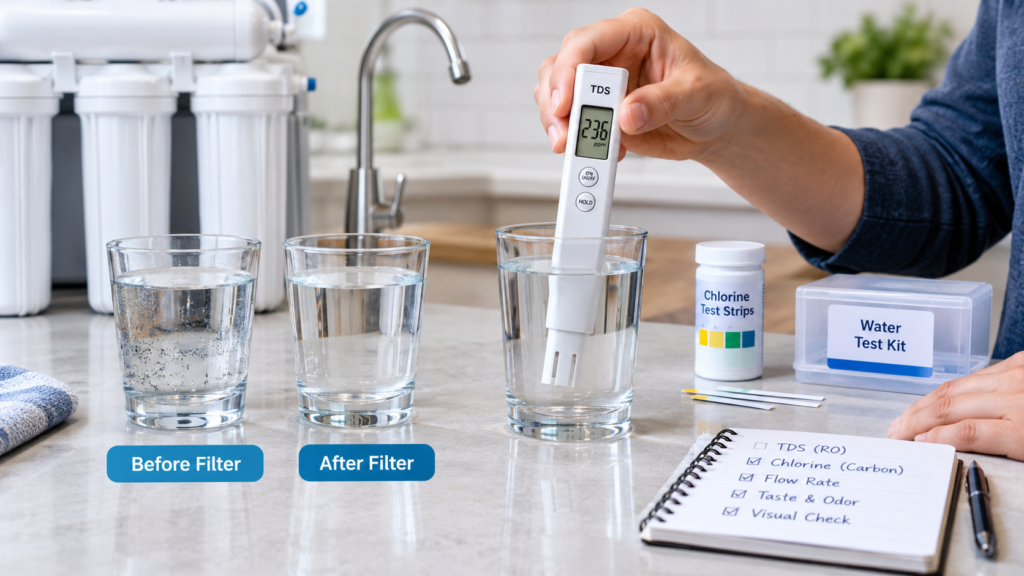
Introduction
How to Test If Your Water Filter Is Working Properly at HomeYour filtered water tastes a little off, the flow has slowed, and you can’t tell whether the cartridge is failing or you’re imagining it. You can settle the question in about 15 minutes with a few inexpensive tools, and the right test depends on the type of filter you own.
Table of Contents
Quick Answer: Test your water filter by comparing the water before and after it passes through the filter. For RO systems, a TDS metre should show roughly 90% or more reduction; for carbon filters, a chlorine test strip should read near zero. Taste, odour, or flow changes signal failure. Only a certified lab can confirm lead, PFAS, or bacteria removal.
What You Need to Know
- The most reliable home method is a before-and-after comparison of unfiltered and filtered water.
- A TDS metre verifies reverse osmosis (RO) systems but cannot verify carbon filters, because carbon does not remove dissolved minerals.
- Taste, odour, and flow changes are early warnings, not proof.
- Home kits cannot confirm lead, PFAS, or bacteria removal. A certified lab can.
- A failed test usually traces to an expired cartridge, a skipped flush, or a filter that was never rated for the contaminant.
How Do I Know If My Water Filter Is Working?
Compare water before and after the filter, then check the result against what that filter is rated to remove. A filter is working only if the measurable contaminant it targets goes down. Follow these steps:
- Read your filter’s claims. Find the model’s performance data sheet or box and note what it is rated to reduce, such as chlorine, lead, or dissolved solids. A test result only means something against a claim.
- Flush the filter first. Follow the manual’s flush time. If it gives none, run cold water through the filter for at least 5 minutes before the first reading. That is a conservative practice, not an industry standard.
- Take the “before” sample. Collect water from the nearest unfiltered cold tap, such as a bathroom sink. Use a clean glass container.
- Take the “after” sample. Collect water from the filtered tap within a few minutes, at the same temperature.
- Measure both and compare. Use the same tool on both samples, write down the numbers, and compare them to the filter’s rating.
Before You Test: Why Flushing Matters
A brand-new cartridge can release trapped air and loose carbon particles, so early samples can look cloudy and read oddly. Test only after the manufacturer’s flush is complete. If you plan to send a lab sample, check both the filter manual and the lab’s instructions for wait times, because they vary.
The NSF consumer guide on water filters, testing, and treatment explains how to read certification claims. Do that before you test, so you know what your filter was actually certified to do
What Are the 5 Ways to Test a Water Filter at Home?
Five methods cover most households, from a free 2-minute check to a certified lab report. Use at least one measurement method, not just taste. Each one is below..
1. Before-and-after TDS reading (best for RO)
A TDS meter is a handheld conductivity probe that estimates total dissolved solids in parts per million (ppm), used to compare water before and after treatment.
- Rinse the probe with distilled water, then dip it in the unfiltered sample.
- Wait for the number to settle as your meter’s manual describes, and record it.
- Rinse again and measure the filtered sample.
- Repeat three times per sample and average the readings to reduce error.
According to the EPA’s secondary drinking water standards, 500 mg/L is the recommended limit for TDS, and it is based on taste and appearance rather than health. A low TDS reading therefore does not prove the water is safe.
2. Test strips and kits (best for carbon and softeners)
Dip a chlorine strip in both samples and read it at the exact time printed on the package, because late reads shift the color. A working carbon filter should drop free chlorine toward zero. A working water softener should drop hardness toward zero.
One catch: if your utility disinfects with chloramine rather than chlorine, use a total chlorine strip and confirm that your carbon filter is rated for chloramine. Standard carbon is less effective against it.
3. Flow, taste, and smell checks (early warning only)
Time how long the filtered tap takes to fill a 1-liter jug when the cartridge is new, and write that number on the housing. Repeat monthly. A rising fill time shows clogging, which usually means the cartridge is near the end of its life.
Taste and odor changes, a cloudy glass, or an indicator light all justify a real test. None of them proves what the filter is or isn’t removing.
4. Inspect the cartridge, then replace and compare
Then check the cartridge for discoloration, cracks, slime, or a worn O-ring seal.
Install a new cartridge, flush it, and repeat your measurement. If the numbers improve, the old cartridge was spent. If they don’t, the problem sits elsewhere in the system
5. Certified lab test (the only proof for lead, PFAS, bacteria)
Send a before sample and an after sample to a certified lab and ask for the contaminants your filter claims to remove. The EPA keeps a directory of certified drinking water labs by state.
Which Test Proves Which Filter?
The test must match the technology, or the result misleads you. A TDS meter can only verify filters that remove dissolved solids. Use this reference:
| Filter type | Best home test | What it can prove | What it can’t prove | Lab needed? |
|---|---|---|---|---|
| Carbon (pitcher, faucet, fridge, under-sink) | Chlorine strip, taste, flow time | Chlorine and odor removal | Lead, PFAS, bacteria, TDS | Yes, for health claims |
| Whole-house carbon | Chlorine strip at two taps | Chlorine reduction through the house | Contaminants added by old pipes | Yes, for health claims |
| Sediment | Clear-glass check, flow time or pressure drop | Particle capture | Dissolved contaminants | No, for particles |
| Reverse osmosis (RO) | TDS meter, before and after | Dissolved-solids rejection | Lead or PFAS specifically | Yes, for specific contaminants |
| Water softener (ion exchange) | Hardness strip | Hardness removal | Anything else | No, for hardness |
Save or screenshot this filter-to-test matrix. It covers which home test fits your filter and where a lab becomes necessary.
The surprising part: a working carbon filter will leave your TDS reading almost unchanged. Many owners see that number, assume the filter has failed, and replace a cartridge that was fine.
How Do I Check If an RO Filter Is Working?
Measure TDS in the tap water and in the RO product water, then calculate the rejection rate. A healthy RO system lands near the rejection rate on its data sheet, which for household units is commonly 90% or higher.
The formula is rejection % = (feed TDS − product TDS) ÷ feed TDS × 100.
Worked example (illustrative numbers):
- Tap water reads 300 ppm, and RO water reads 15 ppm: (300 − 15) ÷ 300 × 100 = 95% rejection. That is healthy.
- Tap water reads 300 ppm, and RO water reads 60 ppm: (300 − 60) ÷ 300 × 100 = 80% rejection. That is below the typical range and points to a worn membrane, a failed seal, or a spent prefilter.
RO also removes minerals along with contaminants, which is why the TDS drops so sharply. Our guide on whether reverse osmosis removes essential minerals covers what that means for drinking water.
Why Can a “Working” Filter Still Give Bad Water?
A filter can perform exactly as rated and still deliver water you don’t want to drink. The most common reason is that the filter was never rated for the contaminant, or contamination happens after the filter.
- Wrong filter type. A sediment filter will not remove dissolved chemicals, and a basic carbon filter will not reduce dissolved minerals.
- Recontamination after filtration. A whole-house unit cannot clean water that picks up metals from old pipes between the filter and your tap.
- Bypass or damage. A cracked cartridge, a torn membrane, or a loose seal lets untreated water take the path of least resistance.
If you’re comparing system types, our breakdown of an RV water filter versus a house filter shows how different designs handle these limits.
What Should I Do If My Filter Fails the Test?
A failed reading rarely means the whole system is broken. Work through the causes in order, from cheapest to most expensive.
- Confirm the test. Repeat the measurement three times and check that you sampled the right taps.
- Check the cartridge date. If it is past the manufacturer’s rating, replace it.
- Flush and retest. Run the flush as the manual specifies, then measure again.
- Inspect the housing and seals. Look for cracks, a pinched O-ring, or a cartridge that isn’t seated.
- Match the filter to the contaminant. Compare your data sheet’s claims to what you are trying to remove.
- Call a professional if results stay bad after a fresh cartridge and a correct installation.
What Are the Most Common Water Filter Testing Mistakes?
Most bad results come from the testing process, not the filter. The most frequent error is using the wrong test for the filter type.
- Testing straight out of the box without flushing, so air and carbon fines distort the reading.
- Using a TDS meter on a carbon filter and concluding that it failed.
- Testing only the filtered water, which gives you a number with nothing to compare against.
- Sampling from different taps, or at different temperatures, so the comparison isn’t fair.
- Trusting a calendar or an indicator light alone. Hard water, high usage, and sediment can use up a cartridge before the date.
- Treating a low TDS as proof of safety. TDS says nothing about lead, PFAS, or bacteria.
When Should I Call a Professional or a Lab?
Home tests have limits. If your concern is a health contaminant, a certified lab result is the only dependable answer. Go to a lab or a professional in these cases:
- You rely on private well water. The CDC publishes guidelines for testing well water, and private wells are not regulated like public supplies.
- Infants, pregnant people, or immunocompromised people drink the water.
- You received a boil-water notice or suspect lead in older plumbing.
- Results stay poor after a fresh cartridge and a correct install.
If you’re on a public supply, your utility’s annual report is a useful baseline. The EPA explains how to find it on its Consumer Confidence Report page.
How Often Should You Replace a Water Filter?
Replace a filter on the manufacturer’s schedule, or sooner if a test or your flow-time check says it’s spent. Your own measurements should override the calendar. Heavy use and sediment-rich water can shorten cartridge life.
Our guide on how often to replace an RV water filter lays out replacement timing in detail. RV owners can apply the same before-and-after tests on the road, since travel water quality changes from stop to stop.
FAQs
How do I know if my water filter is working properly?
Compare water before and after the filter. For RO systems, use a TDS meter and expect a large drop, roughly 90% or more of the incoming reading. For carbon filters, use a chlorine test strip and expect a reading near zero. Falling flow, new taste or odor, and an expired cartridge also signal trouble. Lead, PFAS, and bacteria need a certified lab test.
How do I test filtered water at home?
Collect a sample from the filtered tap and a second from an unfiltered cold tap, then measure both with the same tool. A TDS meter shows dissolved solids, chlorine strips show disinfectant removal, and hardness strips show softener performance. Record both readings and compare. Home tests cover common parameters only; contaminants like lead and PFAS require a lab.
How do I check if an RO filter is working or not?
Measure TDS in the tap water and in the RO product water, then calculate rejection: (feed − product) ÷ feed × 100. A household RO system should land near the rejection rate on its data sheet, commonly 90% or higher. A falling rejection percentage over time points to a worn membrane or a failed seal.
How do I check if a filter is working or not?
Run a quick three-part check: look at flow rate, taste and smell, and the replacement date. Then confirm with a measurement, such as a TDS meter for RO or a chlorine strip for carbon. Sensory changes only suggest a problem. A before-and-after reading is what confirms whether the filter still removes what it is rated to remove.
How long after installing a new filter should I test?
Follow the manufacturer’s flush instructions first, since trapped air and carbon fines can cloud water and muddy early results. For TDS or strip tests, take readings after the flush is complete. For a lab sample, allow the system to settle before collecting; labs and manufacturers set their own wait times, so check both. Do not test straight out of the box.
Does a carbon filter lower TDS?
Not meaningfully. Activated carbon adsorbs chlorine, odors, and many organic compounds, but dissolved minerals pass through, so TDS readings stay nearly the same. Unchanged TDS is therefore normal for a working carbon filter. Use a chlorine test strip instead, and read a drop toward zero as the sign that the carbon is still active.
Can home test strips detect lead or PFAS?
Standard strips cannot confirm PFAS or bacteria, and strips that screen for lead are only a rough indicator. PFAS requires specialized lab analysis, and bacteria testing needs a lab or a dedicated bacteria kit. If lead or PFAS is the reason you bought the filter, a certified lab before-and-after test is the only dependable proof.
What to Do Next
- Your filter passed? Set a reminder and learn the schedule in our guide to how often to replace an RV water filter.
- Your RO reading looked very low? Read whether reverse osmosis removes essential minerals before you decide whether to change anything.
- Not sure your system suits your water? Compare designs in our RV versus house filter guide.