
Introduction
Alkaline Water Filter Pros and Cons: Is Daily Drinking Safe?You’re about to spend money on an alkaline water filter, and every review promises something different. Here is the straight answer, with the research behind it, so you can decide before you buy.
Table of Contents
Quick Answer:Alkaline water filters raise pH to roughly 8–9 and may add minerals, but health benefits are unproven, your body regulates its own pH, and many don’t remove contaminants like lead. Daily use is low-risk for most healthy adults; people on acid blockers or with kidney disease should ask a doctor first.
What You Need to Know
- Alkaline filters change pH and taste. They are not automatically purifiers.
- Your kidneys and lungs hold blood pH between 7.35 and 7.45, whatever you drink.
- Tap water at the top of the EPA’s recommended range is already close to “alkaline.”
- Water above pH 9 tastes bitter, and people on acid-blocking drugs or with kidney disease should check with a doctor first.
- Judge any filter by what it removes and what its cartridges cost, not by its pH number.
Is an Alkaline Water Filter Good for Daily Drinking?
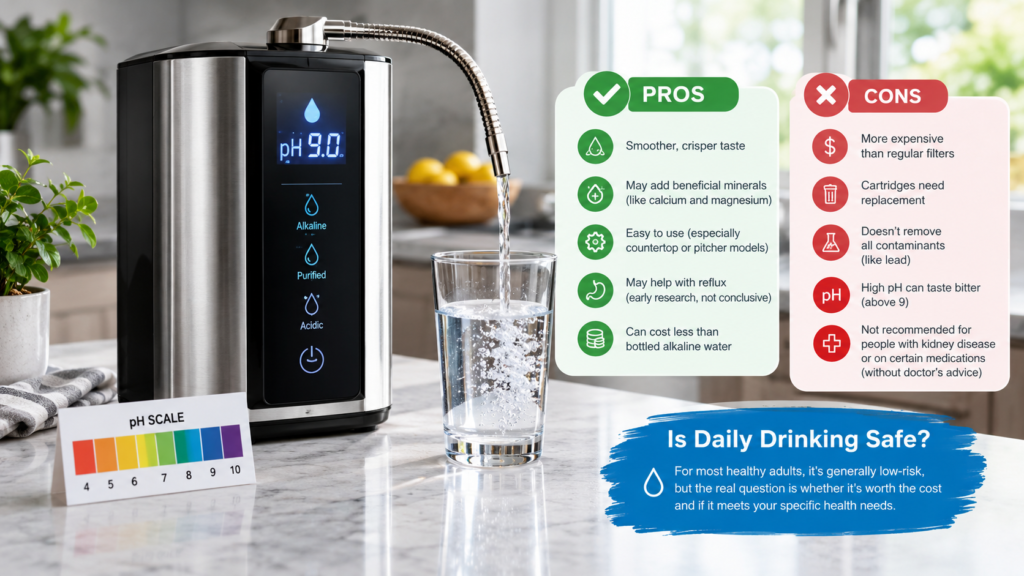
For most healthy adults, daily use is safe enough. The better question is whether it earns its price. Drinking alkaline water every day appears low-risk but has no proven health payoff.
Some people like the smoother taste and the added minerals. That is a legitimate reason to buy one. Just don’t buy one expecting to change your body chemistry.
What Does an Alkaline Water Filter Actually Do?
An alkaline water filter is a device that raises the pH of drinking water, usually by adding minerals such as calcium and magnesium, used to improve taste and push the reading above neutral. Most of these units adjust pH and mineral content; they don’t necessarily clean the water.
There are two common methods:
- Mineral cartridges add alkaline minerals as water passes through.
- Electrolysis (ionisers) uses electricity to split water into alkaline and acidic streams. Ionised water may contain few or no minerals, depending on processing.
Why Doesn’t Your Body’s pH Follow Your Water?
Your stomach is built to be acidic. According to Harvard Health Publishing, stomach fluid usually sits at pH 1.5 to 3.5, so alkaline water entering it makes little lasting difference.
Your kidneys do the rest. Even if you raised blood pH slightly, Harvard Health Publishing notes the kidneys would quickly rebalance it. The body treats drinking water as an input to manage, not an instruction to follow.
The pH Reference Ladder
| Item | Typical pH | Source |
|---|---|---|
| Stomach fluid | 1.5–3.5 | Harvard Health Publishing |
| Lemon juice | About 2 | Common reference value |
| Neutral water | 7.0 | Standard pH scale |
| Healthy blood | 7.35–7.45 | Harvard Health Publishing |
| Regulated tap water | 6.5–8.5 recommended | U.S. EPA, as reported by Harvard Health Publishing |
| Bottled alkaline water | 8–9 | Harvard Health Publishing |
| Water above pH 9 | Often bitter | Harvard Health Publishing |
Save or screenshot this pH reference ladder: it shows at a glance why a pH of 8.5 on the box proves very little.
Here is the surprising part. The upper end of the EPA’s recommended tap range (8.5) already overlaps the bottom of “alkaline” water (8–9). Your tap water may be nearly as alkaline as the water you are about to pay extra for.
What Are the Pros of Alkaline Water Filters?
The genuine advantages are taste, convenience, and possible mineral content. Every pro comes with a caveat that the marketing leaves out.
| Pro | Reality check |
|---|---|
| Smoother, crisper taste | Subjective; many people do notice it |
| Added calcium and magnesium | Varies by model; ionized water may contain none |
| Easy countertop or pitcher use | True, with little installation |
| Possible reflux comfort | Lab-only evidence (see below); relief would be temporary |
| Can cost less than bottled alkaline water | Depends on cartridge price and replacement schedule |
On reflux: a laboratory study on PubMed (study 22844861) found that water at pH 8.8 deactivated pepsin, a digestive enzyme involved in reflux. Human evidence is limited. Harvard Health Publishing adds that antacids and acid-blocking drugs are much more effective.
What Are the Disadvantages of Alkaline Water Filters?
The main disadvantages are unproven benefits, uneven contaminant removal, and ongoing cost. A higher pH reading is not a safety certificate.
Contaminants It May Not Remove
Many alkaline filters adjust pH and add minerals without reducing lead, pesticides, or industrial byproducts. If your tap water carries those, you need a filter certified for them. Look for NSF/ANSI certification on the specific claim, such as NSF/ANSI 53 for health-related contaminants like lead. [URL TO VERIFY: NSF certification explainer]
Bitterness Above pH 9
Harvard Health Publishing reports that water above pH 9 will likely taste bitter. A stronger setting is not a better setting.
Cost and Cartridge Upkeep
The sticker price is only the start. Use this formula before buying:
Yearly cost = cartridge price × cartridges needed per year + unit price ÷ years you’ll keep it
[DATA MISSING: typical cartridge prices and replacement intervals. Fill from the manufacturer’s page for the model you review.
Is It Good to Drink Alkaline Water Every Day?
For most healthy adults, yes, it appears low-risk. Daily use is a taste choice, not a health intervention. Keep the pH at 9 or below and make sure the tap water going in is safe.
A 2016 meta-analysis in BMJ Open found no solid evidence that an alkaline diet prevents or treats cancer, so ignore any filter claiming disease protection.
Who Should Skip It or Ask a Doctor First?
People taking acid-blocking drugs or with kidney disease should talk to a doctor before drinking alkaline water regularly. Strongly alkaline water is the concern, not the average filter.
According to Harvard Health Publishing, adding strongly alkaline water on top of proton pump inhibitors (PPIs) could raise blood pH and shift potassium levels, especially with kidney disease.
Save or screenshot this decision table: it matches the common situations to a sensible next step.
| Your situation | Verdict | Why |
|---|---|---|
| Healthy adult, safe tap water | Optional | Low-risk; mostly a taste upgrade |
| Occasional heartburn | Don’t rely on it | Any relief is temporary; antacids work better |
| Take a PPI or other acid-blocker | Ask your doctor first | Strong alkaline water could shift blood pH |
| Kidney disease | Ask your doctor first | Blood chemistry, including potassium, may be affected |
| Worried about lead or other contaminants | Fix filtration first | pH adjustment doesn’t remove them |
| Persistent heartburn | See a doctor | Water is not a treatment |
Alkaline vs. RO vs. Carbon Filters: What’s the Difference?
Alkaline filters change pH, reverse osmosis (RO) filters remove contaminants, and carbon filters mainly improve taste and remove chlorine. Contaminant removal, not pH, should decide which you buy.
| Filter type | Main job | Typical effect on pH | Best when |
|---|---|---|---|
| Alkaline filter | Raise pH, add minerals | Rises to about 8–9 | Taste is your priority and tap water is already safe |
| Reverse osmosis | Remove a wide range of contaminants | Neutral to slightly acidic | You want maximum contaminant removal |
| Activated carbon | Reduce chlorine and taste issues | Little change | You want a simple taste improvement |
Some households pair RO with an alkalizing stage afterward to restore minerals and taste.
How Do You Read Alkaline Water Filter Reviews?
Ignore the headline score and check five specifics. A review that only praises taste or pH tells you nothing about safety.
- Find the pH range the unit produces. Aim for about 8–9, and be wary of settings above 9.
- Check what it removes. Look for named contaminants with certification, such as NSF/ANSI 53 for lead.
- Calculate cartridge cost per year. Use the formula above.
- Read the health claims skeptically. Cancer prevention and detox claims have no solid evidence behind them.
- Confirm the mineral source. Cartridge-based units add minerals; ionizers may not.
Want this as a one-page printout? Join the newsletter for the free Water Filter Decision Checklist before you shop. [EMAIL CAPTURE POINT]
If You Do Buy a Countertop Filter, What Should You Do Next?
Maintain it, because a neglected filter stops doing its job. Cleaning on schedule matters as much as the model you choose. Once your filter is installed, follow this guide on how to clean and maintain a countertop water filter.
What Are Common Mistakes When Buying an Alkaline Water Filter?
Most mistakes come from mixing up pH with purity. The costliest error is assuming a high pH means clean water.
- Treating pH as a purity score. pH says nothing about lead or pesticides.
- Chasing pH above 9. You get bitterness, not benefits.
- Skipping the tap water check. If your source is contaminated, fix that first.
- Trusting disease claims. Evidence doesn’t support them.
- Ignoring cartridge costs. The ongoing cost often exceeds the unit price.
- Using it instead of a doctor for reflux. Persistent heartburn needs medical attention..
FAQ
What is the disadvantage of drinking alkaline water?
The main disadvantages are unproven benefits, cost, and uneven contaminant removal. Water above pH 9 tastes bitter, and Harvard Health Publishing warns strongly alkaline water could be risky for people taking proton pump inhibitors or with kidney disease. Many alkaline filters adjust pH without reducing contaminants like lead, so the filter can cost more without making water safer.
Why do Japanese drink alkaline water?
For most healthy adults, daily alkaline water appears low-risk but not proven beneficial. Your kidneys and lungs keep blood pH between 7.35 and 7.45 whatever you drink. Keep water at pH 9 or below, make sure the tap water underneath is safe, and ask a doctor first if you take acid-blocking medication or have kidney disease.
What are the disadvantages of using an alkaline water purifier?
Calling it a purifier is the first problem, because many units only raise pH and add minerals. Disadvantages include limited contaminant removal, cartridge costs, and no proven health payoff. If your tap water carries lead or other contaminants, a certified contaminant-reducing filter should come first, with any alkalizing stage added afterward for taste.
Why do Japanese drink alkaline water?
Popularity is not evidence. [DATA MISSING: Add a sourced explanation of how Japan regulates and markets alkaline electrolyzed water before publishing.] Whatever the cultural reasons, the evidence in this article applies everywhere: stomach acid and the kidneys regulate pH, so choosing alkaline water over safe tap water has no demonstrated health advantage.
Does alkaline water change your body’s pH?
Not meaningfully. Healthy blood pH stays between 7.35 and 7.45 because the kidneys and lungs regulate it. Alkaline water entering the stomach, which sits at pH 1.5 to 3.5 according to Harvard Health Publishing, makes little lasting difference. Any shift would be temporary and quickly corrected by your body.
Does an alkaline water filter remove lead?
Not necessarily. Many alkaline filters raise pH and add minerals without removing lead, pesticides, or industrial chemicals. Check whether the specific model carries certification for the contaminant you’re worried about, such as NSF/ANSI 53 for lead. If it doesn’t, pair it with a certified filter or choose a different unit.
Does alkaline water help acid reflux?
Only weakly and temporarily. A laboratory study found water at pH 8.8 deactivated pepsin, an enzyme involved in reflux, but human evidence is limited. Harvard Health Publishing says relief would be temporary and that antacids and acid-blocking drugs are more effective. Persistent heartburn deserves a doctor’s visit, not a filter.
What to Do Next
- Check your tap water first. [CONTENT GAP: how to test your tap water]
- Compare filter types. [CONTENT GAP: alkaline vs RO vs carbon filter comparison]
- Keep your filter working. Follow the guide to clean and maintain a countertop water filter.