
introduction
How Often Should You Replace an RV Water Filter Your tap water just came out cloudy, or you’re standing in the RV lot before a trip trying to remember the last time you touched the filter housing. Either way, there’s a straight answer, and it depends on exactly two things: what kind of filter you have and how hard you use it
Table of Contents
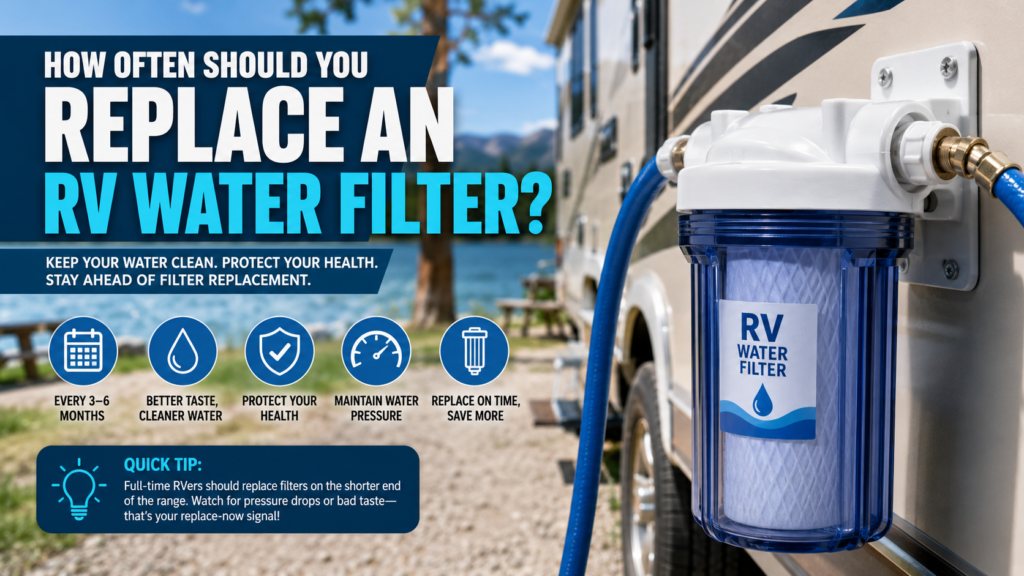
Quick Answer: Most RV water filters need replacing every 3–6 months. Sediment and carbon filters fall on the shorter end (3–6 months), RO pre-filters need swapping every 6 months, and RO membranes can run 2–3 years. Full-time RVers should replace on the shorter end of any range; occasional weekend campers can stretch toward the longer end.
What You Need to Know
- Sediment and carbon filters should be replaced every 3–6 months for most RVers.
- RO membranes last far longer—2–3 years—but the pre-filter protecting them still needs 6-month swaps.
- Full-time use, well water, or campground hookups shorten every interval below.
- A drop in water pressure or a change in taste is a replace-now signal, regardless of the calendar.
- Filters left unused in storage can still need replacing before you dewinterize.
How Often Should You Replace an RV Water Filter?
The general rule is 3 to 6 months, but that number moves depending on filter type and usage. A sediment or carbon filter working through campground water gets used up faster than the same filter fed by clean municipal hookups.
Think of it less as a fixed calendar date and more as a range you narrow down using two variables: what’s inside the filter housing, and how many gallons you’re pushing through it.
Replacement Schedule by Filter Type and Usage
Here’s the piece most guides leave out: a single table that cross-references filter type against how often you actually use your RV. Save or screenshot this schedule—it covers every common RV filtration setup in one lookup, instead of forcing you to combine two separate lists yourself.
| Filter Type | Full-Time RVer | Part-Time RVer | Casual/Weekend RVer |
|---|---|---|---|
| Sediment (pre-filter) | Every 3 months | Every 4–5 months | Every 6 months |
| Carbon block | Every 3 months | Every 4–5 months | Every 6 months |
| RO pre-filter | Every 4–6 months | Every 6 months | Every 6–8 months |
| RO membrane | Every 2 years | Every 2–3 years | Every 3 years |
| Ceramic (cleanable) | Clean monthly, replace at 12 months | Clean every 2–3 months, replace at 12–18 months | Replace annually |
As a gallons-based backup metric, most sediment and carbon cartridges are rated for roughly 1,500–3,000 gallons before efficiency drops—check your specific filter’s packaging, since capacity varies by brand and micron rating.
Sediment & Carbon Filters
These are the workhorses in most RV setups, and they’re also the filters that clog fastest because they physically trap dirt, rust, and chlorine. Once the fine mesh fills up, water pressure drops before contamination becomes visible.
RO Membranes and Pre-Filters
A reverse osmosis membrane is a semi-permeable barrier that forces water through microscopic pores, used for removing dissolved solids a sediment filter can’t touch. The membrane itself is durable — 2 to 3 years is typical — but only if the pre-filter ahead of it is swapped on schedule, since a spent pre-filter lets sediment reach and damage the membrane prematurely.
Ceramic (Cleanable) Filters
Ceramic filters are the one type built for reuse: the surface can be scrubbed clean with a soft brush multiple times before the filter needs full replacement. That said, the filter media does degrade with each cleaning cycle, so annual replacement is still the safety net even if it still looks fine.
Signs Your RV Water Filter Needs Replacing Now
A schedule is a guideline, not a guarantee — any of these signs mean replace it today, no matter how recently it was installed:
- Noticeably lower water pressure at the faucet
- A metallic, musty, or chlorine-heavy taste that wasn’t there before
- Visible discoloration or a slimy film on the filter housing
- Cloudy or sediment-flecked water straight from the tap
- The filter has simply outlasted the interval in the table above.
According to the Centers for Disease Control and Prevention, water that sits in an aging or overused filter can support bacterial growth that a working filter would normally block—that’s the health case for not stretching a filter past its limit.
What Affects RV Water Filter Lifespan
Three variables move every number in the table above: water source quality drives everything else. Well water, campground spigots, and unfamiliar hookups carry more sediment and chlorine than clean municipal supply, which shortens filter life regardless of type.
Frequency of use matters just as much — a full-timer running water daily works through a filter’s capacity in a fraction of the time a weekend camper does. For a full walkthrough of what filters actually pull out of your water and why source quality matters this much, see what impurities do water filters remove.
Do Filters Need Replacing After Storage or Winterizing?
Yes — a filter that never touched water this season can still fail on day one of next season. Stagnant moisture left in a filter housing over winter is precisely the environment bacteria need to establish, even with zero active use.
If your RV sat in storage for more than a few months, replace the filter before you dewinterise rather than after — running contaminated water through your fresh system defeats the purpose of winterising it correctly in the first place.Our full RV water filter winterizing guide covers the exact sequence for draining, storing, and restarting your system.
Filter vs. Softener: Do You Need Both?
A filter and a softener solve different problems, and most RVers need the filter regardless of whether they add a softener. A filter removes sediment, chlorine, and bacteria; a softener addresses mineral hardness that causes scale buildup in pipes and appliances.
If you’re not sure which one your setup actually needs, or whether you need both stacked together, water filter vs. water softener breaks down exactly when each one earns its place in your water line.
How to Replace Your RV Water Filter
The swap itself takes most RVers under 10 minutes: shut off the water supply, relieve pressure at a faucet, unscrew the housing, drop in the new cartridge, and run a short flush cycle before drinking from it. Getting the flush and reseal steps right matters more than people expect—a poorly reseated housing is the most common cause of a “new filter, same bad taste” complaint.
For the complete step-by-step process, including how long to flush a new filter and how to catch a bad seal before it leaks, see how to maintain a water filter.
Common Mistakes RVers Make With Filter Replacement
The single most common mistake is treating the interval as fixed rather than adjusting it for actual usage. A full-timer using a casual-RVer’s 6-month schedule is running on a compromised filter for months before symptoms show up.
The second most common mistake: skipping the post-storage replacement because “it was never used, so it should still be ‘fine'”—moisture, not usage, is what degrades a stored filter. Third: reusing a sediment or carbon cartridge because it still looks clean on the outside, when the clogging that matters happens inside the filter media where it can’t be seen.
FAQs
How long do RV water filters last?
Most sediment and carbon filters last 3 to 6 months under typical use. RO pre-filters last around 6 months, while the RO membrane itself can run 2 to 3 years. Full-time RVers land on the shorter end of every range; occasional campers can stretch toward the longer end, provided water pressure and taste stay normal.
Is an RV water filter necessary?
Yes, for most RVers connecting to varied water sources like campgrounds, wells, or unfamiliar municipal supplies. A filter is your first line of defense against sediment, chlorine, and bacteria that untreated hookup water can carry, protecting both your health and your RV’s plumbing from buildup and contamination.
Are RV water filters reusable?
Only ceramic filters are designed for reuse—they can be scrubbed clean and reinstalled several times before needing full replacement. Sediment, carbon, and RO membrane filters are not reusable; their filtering media is consumed or clogged during use and can’t be cleaned back to original capacity.
What Are the Signs That an RV Water Filter Should Be Replaced?
You should consider replacing your RV water filter when the water flow becomes weaker, the water develops an unusual taste or smell, or you notice cloudiness or visible particles. These changes can indicate that the filter media is becoming clogged or has reached its useful capacity. Even if the water still looks normal, follow the manufacturer’s recommended replacement interval based on the filter type and how frequently you use your RV.
Does an RV water filter need replacing if it hasn’t been used?
Yes. A filter sitting unused in storage can still develop bacterial growth from residual moisture, even with zero water passing through it. Replace filters before dewinterizing an RV that’s been stored for more than a few months, rather than waiting to see if the old one still works.
Can you run an RV water filter past its recommended lifespan?
You can, but efficiency drops sharply once a filter passes its rated interval or gallon capacity—it may still pass water while filtering out far less. Running past the schedule risks reduced pressure, off tastes, and eventually contaminants passing through untreated, undermining the reason you installed a filter at all
What to Do Next
If your RV is heading into storage soon, start with the winterizing guide so your filter schedule and your storage routine line up. If you’re unsure whether a softener belongs alongside your filter, water filter vs. water softener will settle that. And when it’s time for the actual swap, how to maintain a water filter walks through the full process step by step.